Animal profile
Where to see scalloped hammerheads
Sphyrna lewini
Rare enough to plan the trip around. Odds on a typical dive within its range — the right place and season are what beat them, which is what the destinations below are for.
CRCritically Endangered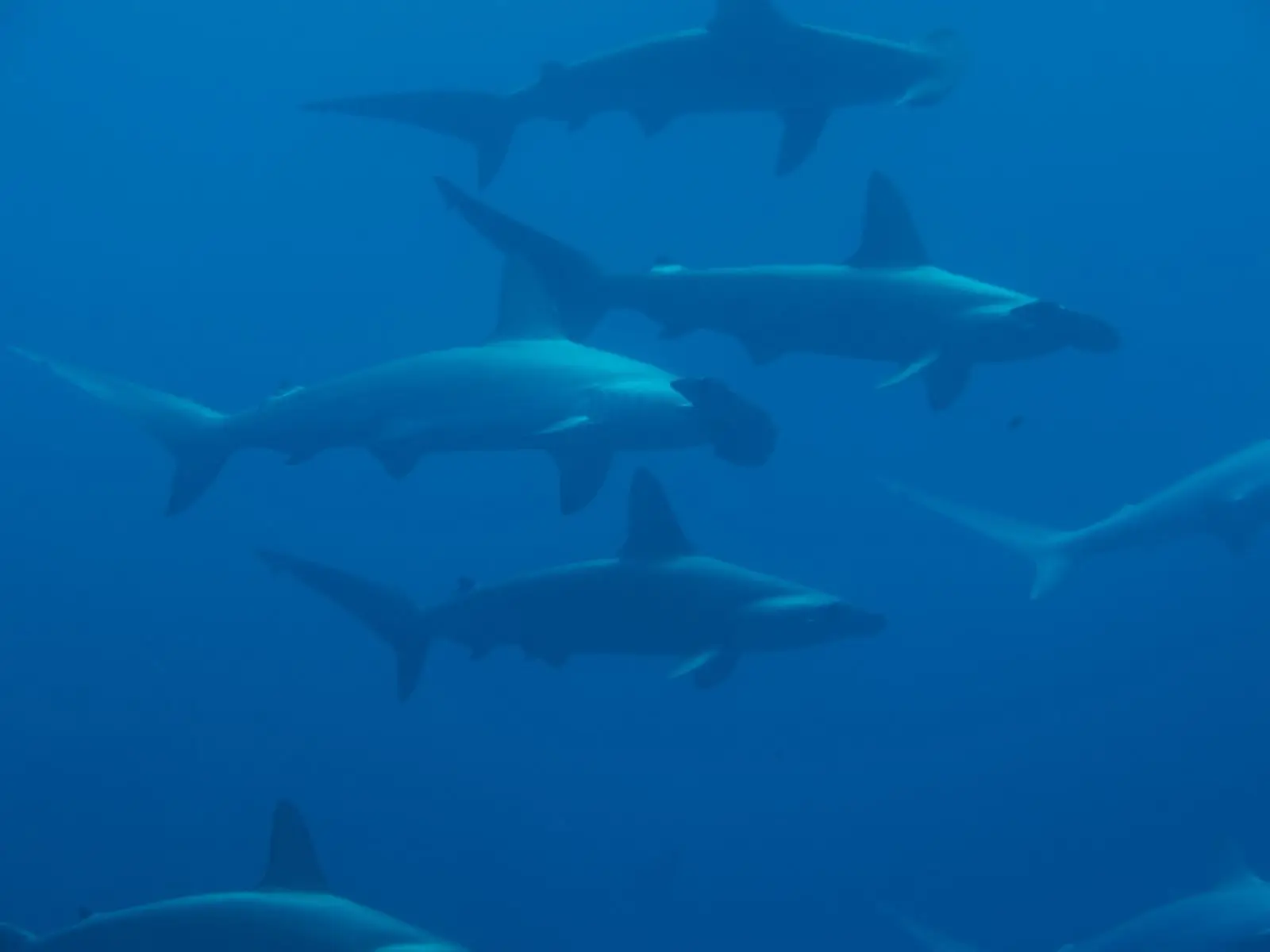
The scalloped hammerhead is named for the notched, scalloped front edge of its wide, flattened head — a cephalofoil that spreads its electro-sensory organs and nostrils over a larger area for better prey detection and gives it a wider field of view. It is the hammerhead that schools: daytime aggregations that can number in the hundreds gather around offshore pinnacles and cleaning stations, a spectacle and, unfortunately, an easy target. Scalloped hammerheads grow slowly and mature late, and the IUCN uplisted them to Critically Endangered in 2019, citing an estimated decline of at least 80% over three generations, driven mainly by the fin trade.
Size
The short version
Lifespan
~30 years
Schools
tens to hundreds when conditions line up
Diet
Bony fish, squid and octopus, and smaller sharks and rays
Risk to youLow
Extremely bubble-shy — the schools break up if you exhale at them.
Risk from us
finning, bycatch, chasing the school — the last one is the part you control.
Planning the encounter
Depth
25–40 m
Recorded between 15 m and 40 m
Night diving
Daylight only
Odds through the day
Dawn
best time
Day
possible
Dusk
unlikely
Night
not seen
Schools hang deep in current at first light and thin out as the day warms. First dive of the day, every time — and it is a deep one, so plan the gas.
Best places to see scalloped hammerheads
How to identify a scalloped hammerhead
- A wide, flattened head with a scalloped — notched — front margin and a central indentation. That scalloping separates it from the great hammerhead (nearly straight margin, taller dorsal) and the smooth (rounded margin, no notch).
- Grey to grey-brown back over a pale underside, with a tall, slightly curved first dorsal fin.
- Almost always in a school, holding in cooler, deeper water over drop-offs and current-swept points — not cruising alone in the shallows.
Meeting them responsibly
- Keep your breathing quiet and your movements slow — they are skittish and bubble noise pushes a school away.
- Never chase or swim toward a school. Hold your depth and let them pass on their own terms.
- Hold your buoyancy off the rock at current-exposed sites; it is easy to crash into the reef while looking up at sharks.
Frequently asked questions
- Where can I dive with scalloped hammerheads?
- Darwin and Wolf in the Galapagos hold the largest, most reliable schools on earth, in the cool June-to-November season. Yonaguni in Okinawa is the winter alternative, with schools off points like Irizaki from December to March.
- Why do they school?
- Scalloped hammerheads form large daytime aggregations around seamounts and cleaning stations. The schooling is thought to serve feeding and social structure, and it is seasonal and predictable — which is exactly what makes the species so vulnerable to fishing.
- Are scalloped hammerheads dangerous?
- No. They eat fish, squid and small rays, and they are famously skittish — the usual problem is that they keep their distance, not that they approach. The International Shark Attack File records no confirmed fatal attacks by hammerhead species.
Check me
The reference records behind this page on scalloped hammerhead.