Animal profile
Where to see tasselled wobbegongs
Eucrossorhinus dasypogon
Regular, but it has to want to be seen. Odds on a typical dive within its range — the right place and season are what beat them, which is what the destinations below are for.
LCLeast Concern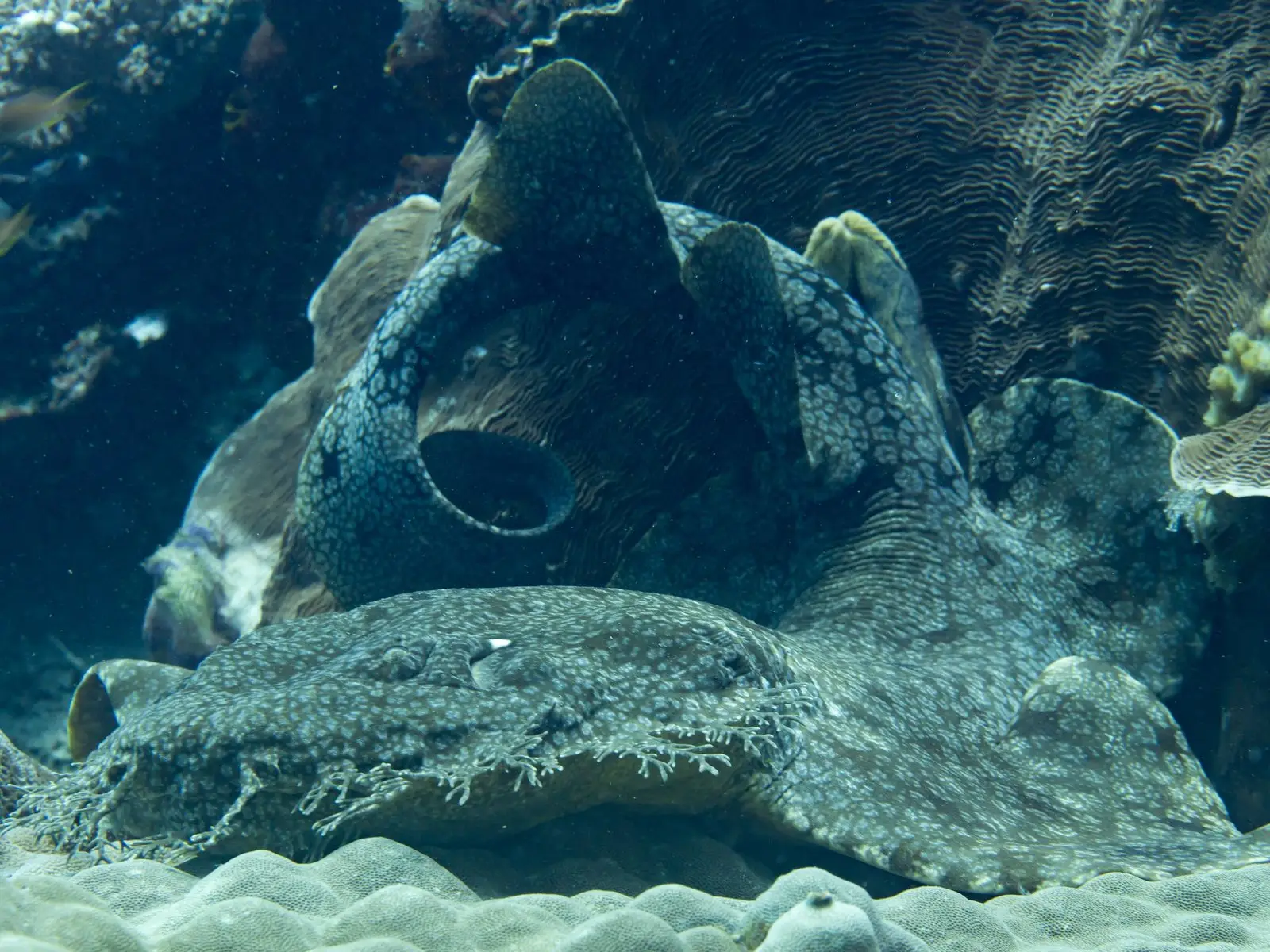
The tasselled wobbegong is a bottom-dwelling carpet shark of the Coral Triangle, ranging from Raja Ampat and New Guinea to northern Australia. A fringe of branching skin flaps — the tassels that name it — runs almost unbroken from the snout to the pectoral fins, including a beard on the chin, and its mottled pattern breaks up its outline against sponge and coral so completely that divers routinely pass within a metre without seeing it. It hunts by ambush: by day it lies motionless under table corals and in cave mouths, and by night it takes fish, crustaceans and cephalopods off the reef — sometimes twitching its eyespot-marked tail to lure prey close before lunging. The IUCN lists it as Least Concern, helped by a range that includes lightly fished corners of northern Australia.
Size
The short version
Solitary
usually met one at a time
Diet
Fish, crustaceans and cephalopods, ambushed at night
Risk to youModerate
Ambush predator that bites hands and fins placed on it; it holds on.
Risk from us
touching, reef damage from poor buoyancy — the last one is the part you control.
Planning the encounter
Depth
5–20 m
Recorded between 3 m and 25 m
Night diving
Better on a night dive
Odds through the day
Dawn
possible
Day
likely
Dusk
likely
Night
likely
A nocturnal ambush hunter, which cuts both ways: by day it is motionless under a table coral and easy to find once your eye is in, by night it is out and moving.
Best places to see tasselled wobbegongs
How to identify a tasselled wobbegong
- A dense, branching fringe of skin flaps — the beard — ringing the entire head and chin, far more elaborate than the simple jaw lobes of a spotted or ornate wobbegong.
- A carpet-like pattern of dark blotches and lines that matches the surrounding sponge and coral rather than any bold marking.
- Look under table corals, ledges and small cave mouths, not in open water. It will be lying perfectly still, beard facing out.
Meeting them responsibly
- Never touch, poke or corner one. It looks inert, but it bites defensively — and it is hard to detach once it has.
- Watch where your hands and fins land when you look under a ledge or table coral. It won't move away, so accidental contact is on you.
- Keep a body length back and let the guide point it out rather than reaching in for the photo.
Frequently asked questions
- Where can I see a tasselled wobbegong?
- Raja Ampat in West Papua, Indonesia, is the most reliable place on earth, with resident animals under table corals in the Dampier Strait and around Misool. The species also occurs across New Guinea and northern Australia, but nowhere is as dependable as Raja Ampat.
- How is it different from other wobbegongs?
- The beard. On a tasselled wobbegong the branching skin lobes ring the whole head and chin; on the spotted and ornate wobbegongs of Australia the lobes are simpler and confined to the jaw. The tasselled is widely called the best-camouflaged of all the carpet sharks.
- Is it dangerous?
- Not unless provoked. It won't chase you, but like all wobbegongs it bites defensively if touched or landed on, and it can be hard to release. Because it is so well camouflaged, the real risk is accidental contact — mind your hands and fins near ledges.
Check me
The reference records behind this page on tasselled wobbegong.