Animal profile
Where to see bamboo sharks
Chiloscyllium spp.
Regular, but it has to want to be seen. Odds on a typical dive within its range — the right place and season are what beat them, which is what the destinations below are for.
Varies by species across the genus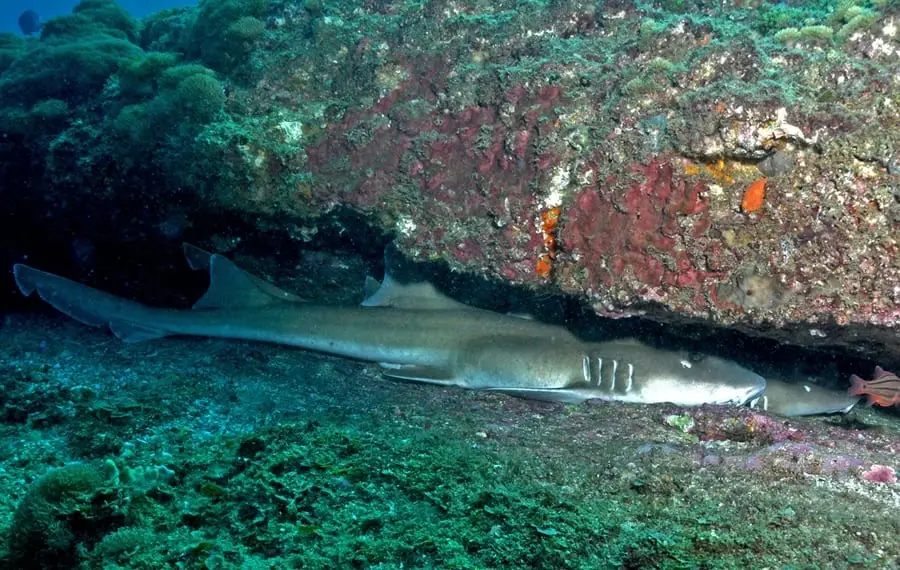
Bamboo sharks are small bottom-dwelling carpet sharks of the Indo-Pacific, and the one Indonesian divers meet most is the brownbanded bamboo shark, Chiloscyllium punctatum. They are built for a life in contact with the reef rather than above it: long and slender, barely a metre or so, with barbels on the snout for finding buried prey and paddle-shaped pectoral fins they use to clamber and prop themselves over rubble. Juveniles carry the bold dark banding the family is named for and lose most of it with age, which is why a big one can look like a plain brown eel-shaped shark and a small one like a different species entirely. They are nocturnal, they sit out the day pushed into a crevice with only a tail showing, and like their epaulette shark relatives they tolerate remarkably low oxygen — a useful trick when your daytime bedroom is a hole with no water moving through it.
Size
The short version
Solitary
usually met one at a time
Diet
Crabs, shrimp, worms and small fish taken from sand and rubble
Risk to youHarmless
Harmless; a small nocturnal bottom-dweller.
Risk from us
handling, aquarium collection — the last one is the part you control.
Planning the encounter
Depth
5–25 m on reef and rubble
Recorded between 0 m and 85 m
Night diving
Better on a night dive
Odds through the day
Dawn
possible
Day
unlikely
Dusk
likely
Night
best time
A nocturnal bottom hunter, and the difference between day and night is the difference between finding a tail under a rock and watching a shark work. Day dives can turn one up if you search the overhangs deliberately; a night dive over rubble is what shows you the animal moving, propped on its pectoral fins, nosing crabs out of the substrate.
Best places to see bamboo sharks
How to identify a bamboo shark
- Look for a slender, almost cylindrical body with two similar dorsal fins set well back, a rounded snout with short barbels, and a tail with almost no lower lobe — a shape much closer to a catshark than to anything on the reef above it.
- Bands are an age marker, not a species marker: juveniles are strongly barred in dark brown, and adults fade to fairly plain brown, sometimes with faint saddles. Do not read a plain adult as a different animal.
- By day you will usually see only part of one — a tail or a head protruding from beneath a rock. Check under overhangs and in rubble rather than scanning open reef, and expect to find it with your eyes rather than have it swim past.
Meeting them responsibly
- Do not pull one out from under its rock. It is small enough to handle and that is exactly the problem: dragging one into the open costs it the shelter it chose and strips protective mucus from its skin.
- Keep your torch off its face on a night dive and give it room to work. These are eyes adapted to near-total darkness, and a beam held on one ends the foraging you were watching.
- Watch your fins in the rubble. This is a camouflaged animal lying still on the bottom, and the realistic risk on a night dive is not that it bites you but that you kneel on it.
Frequently asked questions
- Where can I see a bamboo shark?
- Across shallow Indo-Pacific reefs, and around Bali the sites off Nusa Penida and Nusa Lembongan are the dependable ones. They are found by searching under rocks and ledges by day, or by night diving over rubble when they come out to hunt.
- Are bamboo sharks dangerous?
- No. They are under about a metre and a half, they eat crabs and worms, and they have no interest in divers whatsoever. The only realistic way to be bitten is to pick one up.
- Is it the same as a walking shark?
- They are close relatives in the same order and both clamber on their fins, but the walking sharks are the genus Hemiscyllium, like the epaulette shark. Bamboo sharks are Chiloscyllium — similar habits and shape, different genus, and generally more slender and more strongly banded when young.
Check me
The reference records behind this page on bamboo shark.