Animal profile
Where to see basking sharks
Cetorhinus maximus
Call everyone if you see it. Odds on a typical dive within its range — the right place and season are what beat them, which is what the destinations below are for.
ENEndangered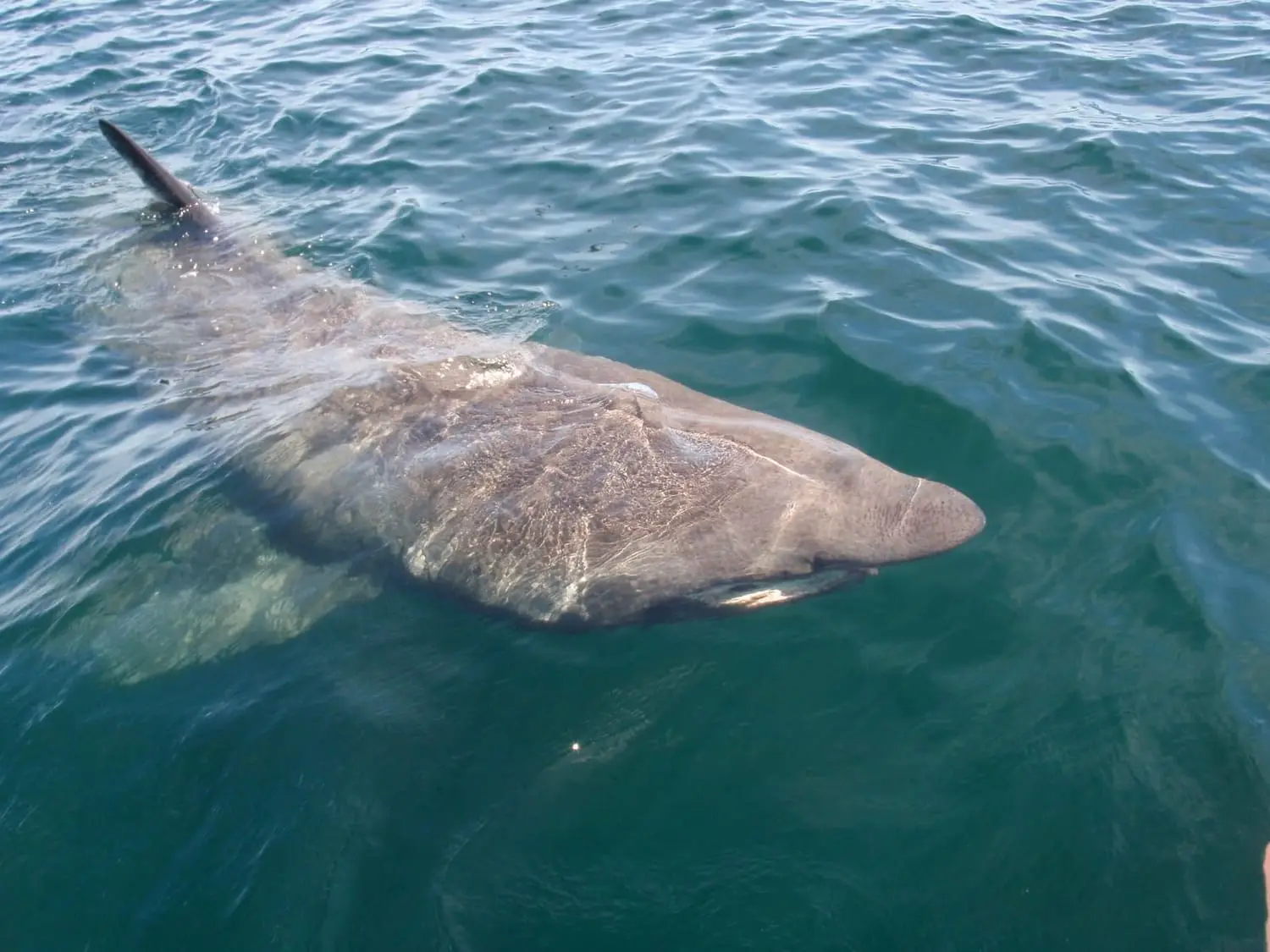
The basking shark is the second-largest fish alive, a slow grey filter-feeder that spends the northern summer trawling plankton fronts with its mouth gaping wide enough to swim into. In Scottish waters it gathers each summer in the Sea of the Hebrides, an area given Marine Protected Area status in 2020 specifically for it. Encounters happen at the surface: a boat spots fins, a small group slips quietly into the water, and the shark passes at its own pace, entirely uninterested in you. Satellite tagging has since shown they also spend long periods near the seabed and, out of season, dive to around 1,000 metres and migrate as far as the Azores and Morocco.
Size
The short version
Lifespan
~50 years
Small groups
a handful in the same spot
Diet
Zooplankton, filtered by swimming slowly with the mouth wide open
Risk to youHarmless
A filter feeder — keep clear of the tail and the boat.
Risk from us
boat strike, entanglement, crowding by boats — the last one is the part you control.
Planning the encounter
Depth
Surface to 5 m
Recorded between 0 m and 10 m
Night diving
Daylight only
Odds through the day
Dawn
unlikely
Day
best time
Dusk
unlikely
Night
not seen
Encounters are daytime and surface-driven. Sharks come up to feed when plankton concentrates near the surface in calm, bright conditions — which is also the only condition in which a skipper can spot fins from a boat. Tagging shows they feed at depth too, and dive to around 1,000 m outside the season, but none of that is reachable by a snorkeller.
Best places to see basking sharks
How to identify a basking shark
- Two fins showing at the surface with a wide gap between them — a tall triangular dorsal, then the tail tip well behind it. No other shark in British waters shows that spacing.
- The open mouth is a huge circular hole with pale gill rakers visible inside, and the gill slits wrap almost the whole way around the head.
- Uniform dull grey-brown, small conical snout, tiny eyes, and a slow unhurried tail beat. Nothing about it looks fast.
Meeting them responsibly
- This is a snorkel encounter, not a dive. Scottish operators do not permit scuba on basking shark trips — bubbles push the sharks down and end the encounter for everyone.
- Let the shark decide. Voluntary codes ask for at least 4 m distance and no more than four people in the water near one animal; never swim at a shark, and never touch. Boats stay 100 m off, and sharks following nose-to-tail are likely courting and need 500 m.
- They are protected under the Wildlife and Countryside Act 1981: intentionally or recklessly killing, injuring, disturbing or harassing one in British waters is a criminal offence.
Frequently asked questions
- Can you scuba dive with basking sharks?
- Not in practice. The licensed Scottish operators run snorkel trips only, because exhaled bubbles push the sharks away from the surface where the encounter happens. A diver who meets one underwater has had a lucky accident, not a planned dive.
- Are basking sharks dangerous?
- No. They filter plankton and have no interest in people at all. The one real hazard is the tail, which is enormous and powerful, so the voluntary codes ask swimmers to stay at least 4 metres clear.
- When is basking shark season in Scotland?
- May to October, with July to September carrying most of the encounters. First arrivals show in April, and the late season is limited more by weather cancellations than by absent sharks.
Check me
The reference records behind this page on basking shark.