Playa del Carmen, Quintana Roo
Where to see bull sharks in Mexico
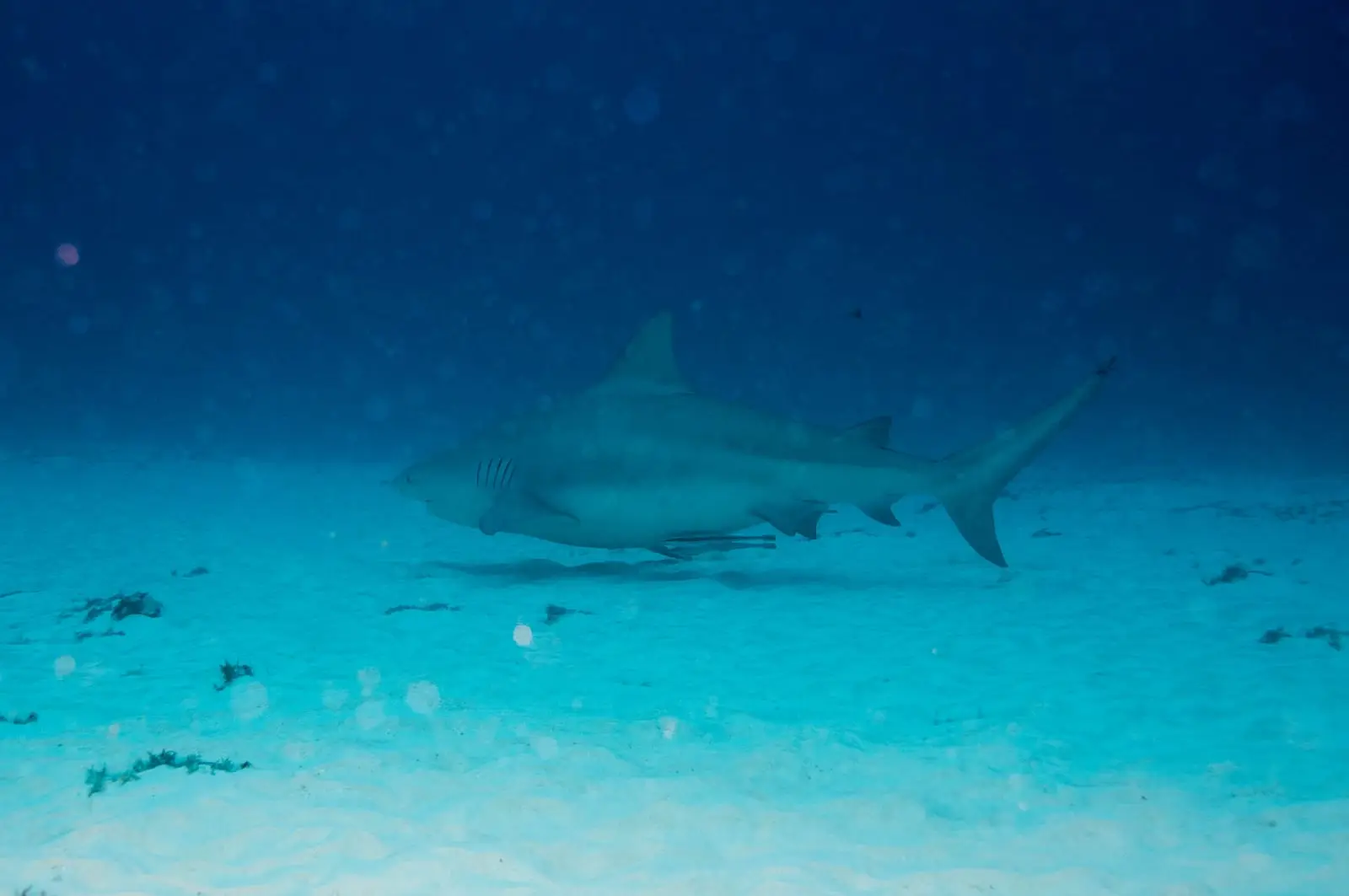
Every winter, pregnant female bull sharks gather in the shallow water directly off Playa del Carmen before pupping in the coastal mangroves, and diving with them is a short boat ride from the town beach. The dives sit on sand at roughly 20–25 metres, run in the early morning, and are guided with a bait box. The season runs from mid-November to March and peaks between December and February, when five to fifteen sharks on a dive is normal.
Best time: Mid-November to March; peak December to February
Well documented, and reliably seen in season.
When to go
The season is tied to pupping rather than to conditions: females arrive from about mid-November, numbers build through December, peak in January and February, and thin out through March. Outside those months the sharks disperse and there is no bull shark dive here at all. Water runs about 25–27°C, and the limiting factor is wind — the nortes blow through the same winter months that bring the sharks.
Best dive sites for bull sharks in Mexico
-
Bull Shark Point
The main site, on open sand at about 20–25 m a few minutes off Mamitas Beach. Divers kneel in a briefed line while a guide works a bait box and the sharks make slow passes across the front.
-
The inshore reef strip
Shallower reef and sand nearby, dived on the same trips as a second tank. Not a shark site as such, but where the season’s turtles, eagle rays and the occasional nurse shark turn up.
How to see them
Book with a Playa del Carmen operator during the season; the boats leave from the town beach and the ride is short. Advanced Open Water is the usual requirement, both for the depth and because the encounter is close-range and position-critical. Go early — the morning boats get the flattest sea and the best visibility, and the whole dive is worth planning around a briefing you actually follow, since the sharks come to a bait box and your job is to stay put. The nortes, the winter north winds, cancel trips outright, so give yourself several days rather than betting on one morning.
What an encounter is like
Five to fifteen bull sharks on a good dive, overwhelmingly large pregnant females of two to three metres, making unhurried passes within a few metres of the line. The water is warm but not tropical-clear this close to shore, and a motionless half-hour on sand is colder than the temperature suggests. Caribbean reef sharks and nurse sharks often join, which makes this a useful place to learn the interdorsal-ridge difference on live animals.
Frequently asked questions
- Is the Playa del Carmen bull shark dive baited?
- Yes. A guide manages a bait box on the sand to bring the sharks within range of a line of kneeling divers. There is no reliable unbaited alternative here, so it is worth knowing you are joining a provisioned dive before you book.
- What certification do I need?
- Advanced Open Water is the standard requirement, mostly because the site sits at about 20–25 m. Beyond the card, what matters is buoyancy good enough to hold a fixed position on sand for the length of the dive.
- Why are they all pregnant females?
- Because that is what the aggregation is for. The females come inshore ahead of pupping and use the nearby mangrove systems as a nursery, which is why the season is so tightly bounded and why the animals you see are so consistently large.
Sources
- Everything You Need to Know About Bull Shark Diving in Playa del Carmen — Xico Dive Center
- Bull Shark Scuba Diving in Playa Del Carmen — Koox Diving
- Dive Site Talk: Bull Shark Point in Playa del Carmen — Blue Life
- Bull Shark Diving in Playa del Carmen – A Seasonal Adventure — Scuba Diving México