Animal profile
Where to see epaulette sharks
Hemiscyllium ocellatum
Regular, but it has to want to be seen. Odds on a typical dive within its range — the right place and season are what beat them, which is what the destinations below are for.
LCLeast Concern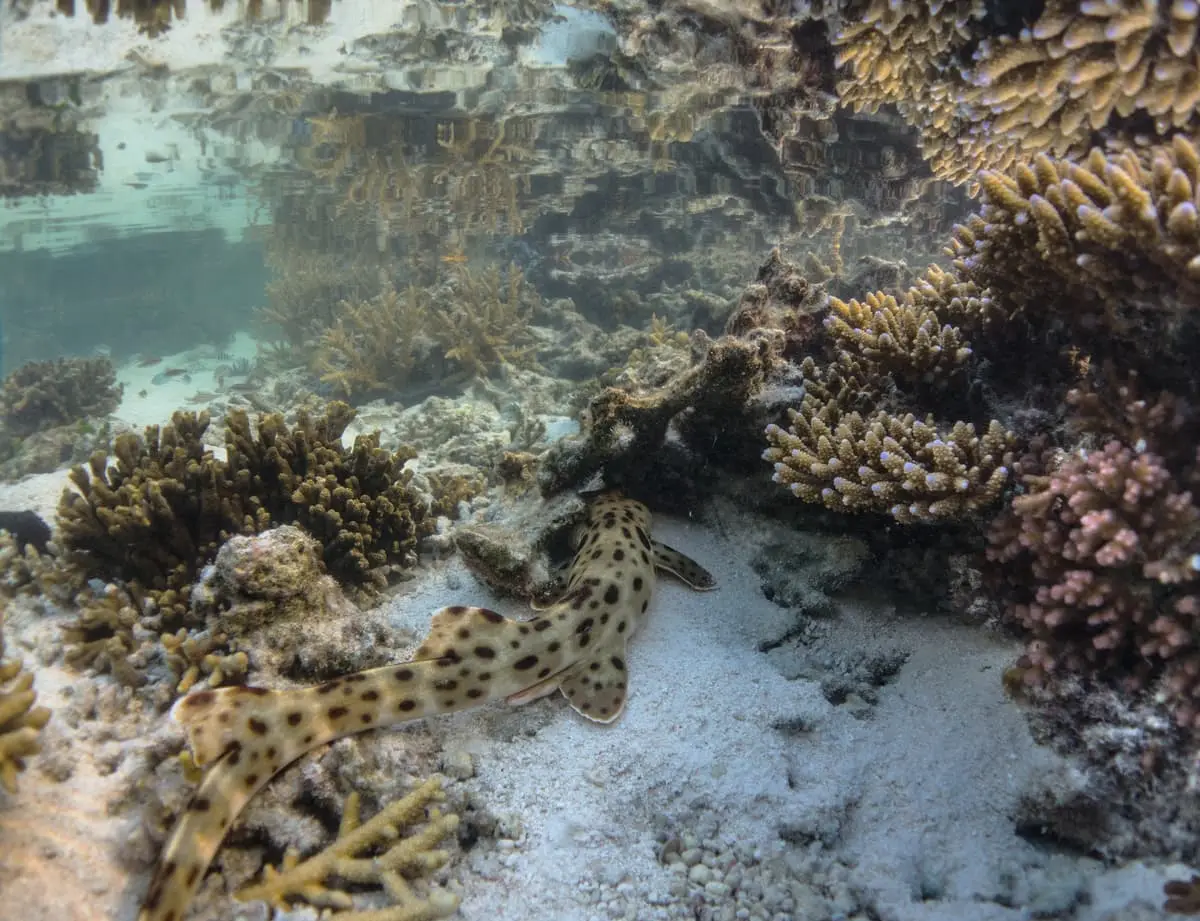
The epaulette shark is a small, slender carpet shark of northern Australia’s shallows, and it is the animal behind every “walking shark” headline. It uses its paddle-like pectoral and pelvic fins to stride across sand and rubble rather than swim, and it will cross exposed reef flat between tide pools when the tide strands it. It survives that gamble because it tolerates oxygen levels that would kill most fish, slowing its heart and shutting down non-essential brain function to endure hours in water that has effectively none — which is why it has become one of the most studied sharks in physiology labs. There are nine walking sharks in the genus, all confined to Australia, Indonesia and Papua New Guinea; this is the Great Barrier Reef one, and Raja Ampat’s walking shark is a different species, Hemiscyllium freycineti.
Size
The short version
Solitary
usually met one at a time
Diet
Worms, crabs, shrimp and small fish, sucked out of sand and rubble
Risk to youHarmless
Small, harmless, and easy to stress — look, do not lift.
Risk from us
handling, aquarium collection — the last one is the part you control.
Planning the encounter
Depth
0–3 m on reef flats
Recorded between 0 m and 50 m
Night diving
Better on a night dive
Odds through the day
Dawn
possible
Day
unlikely
Dusk
likely
Night
best time
A nocturnal forager that spends the day wedged under coral heads and ledges and comes out to hunt after dark, which makes a shallow night dive far and away the best way to see one moving. Tide matters as much as light: the lowest tides concentrate them in pools and channels, and a night dive on a falling tide over a rubble flat is the whole recipe.
Best places to see epaulette sharks
How to identify a epaulette shark
- Look for the epaulette itself: one large black spot behind each pectoral fin, ringed with a clean white margin. It is a false eye, and it is the single feature the species is named for.
- The body is long, slender and almost eel-like, with two dorsal fins set far back toward the tail and no fin spines — nothing about the silhouette reads as a typical shark.
- If it is walking rather than swimming, in less than three metres of water on the Great Barrier Reef, it is this species. Separating it from its congeners means counting and placing spots, but their ranges do not overlap: each walking shark is essentially local to its own patch of the Coral Triangle.
Meeting them responsibly
- Never pick one up. It is small and it does not thrash, which makes it one of the most-handled sharks on the reef, and handling drives it out of the shelter it chose and rubs the protective mucus off its skin.
- Do not move a stranded one toward the water. Being in that tide pool is not an accident — it can wait out low tide on almost no oxygen, and it will walk itself out when it is ready.
- On a night dive, light it obliquely and briefly rather than head-on. This is a nocturnal forager with eyes built for almost no light, and a beam held on its face ends the hunt you came to watch.
Frequently asked questions
- Can epaulette sharks actually walk on land?
- They walk across the sea floor constantly, and they will cross short stretches of exposed reef flat between tide pools — distances of up to about 30 metres have been recorded. It is not a land animal: the trip is a brief, damp crossing at low tide, not a life out of the water.
- Where can I see an epaulette shark?
- The shallow reef flats and lagoons of the southern Great Barrier Reef are the classic place, with Lady Elliot and Heron Islands the best known. They are easiest to find at night or around low tide, when they leave cover to forage in water often less than a metre deep.
- How does it survive with no oxygen?
- It tolerates severe hypoxia by slowing its heart rate and selectively shutting down non-essential brain activity, letting it endure hours in water almost devoid of oxygen without lasting damage. That tolerance is why it turns up so often in medical research on oxygen deprivation.
Check me
The reference records behind this page on epaulette shark.