Animal profile
Where to see great hammerheads
Sphyrna mokarran
Call everyone if you see it. Odds on a typical dive within its range — the right place and season are what beat them, which is what the destinations below are for.
CRCritically Endangered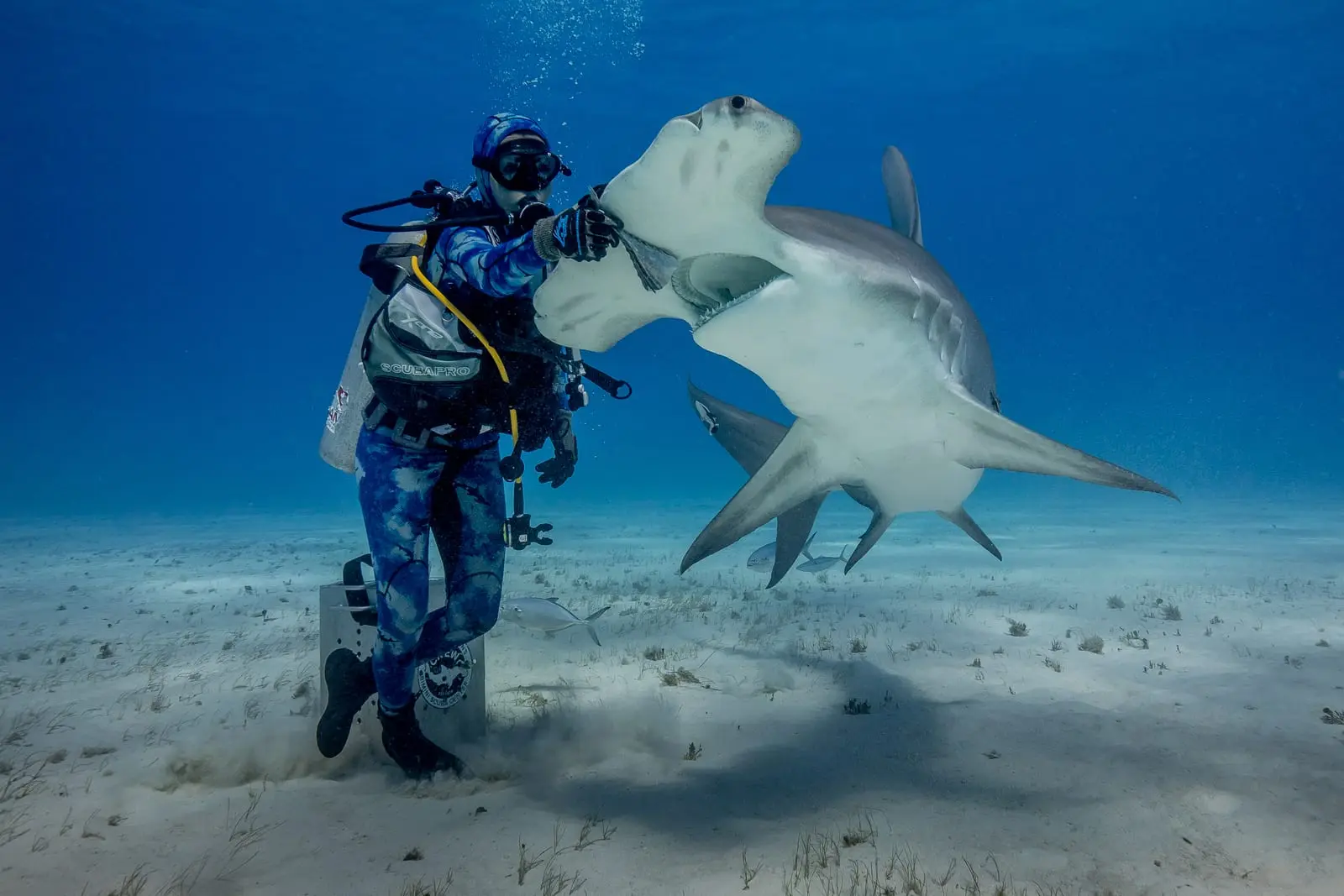
The great hammerhead is the biggest of the hammerhead species and the only one that regularly exceeds five metres. Unlike the scalloped hammerheads that form the famous schools at Darwin, Yonaguni and Monad Shoal, it is solitary and nomadic, roaming reef edges, drop-offs and sand flats across the tropics. It hunts mostly at dawn and dusk, specialising in stingrays that it detects buried in sand and pins down with the flat of its head. It has declined by more than 80% in three generations and is listed as Critically Endangered, which is why almost every reliable encounter on earth now happens on one shallow sand flat in the western Bahamas.
Size
The short version
Lifespan
~40 years
Solitary
usually met one at a time
Diet
Stingrays above all, plus smaller sharks, reef fish, squid and crustaceans
Risk to youLow
Large and confident but not aggressive to divers; dive it with a briefed operator.
Risk from us
finning, bycatch, provisioning — the last one is the part you control.
Planning the encounter
Depth
5–10 m at Bimini
Recorded between 1 m and 80 m
Night diving
Also seen on night dives
Odds through the day
Dawn
likely
Day
possible
Dusk
likely
Night
possible
A crepuscular hunter that works sand flats and reef edges for buried rays around dawn and dusk. It stays active after dark, but night diving is not a practical way to look for one. At Bimini the pattern is different again — the baited dive runs through the afternoon, so the sharks there keep hours set by the boats rather than by the light.
Best places to see great hammerheads
How to identify a great hammerhead
- The dorsal fin is the giveaway: very tall and strongly sickle-shaped, far taller and more curved than any other hammerhead’s.
- The leading edge of the head is nearly straight with a single shallow notch at the middle. A scalloped hammerhead’s front margin has a central indentation plus two more on each side; a smooth hammerhead has no median notch at all.
- It will be alone, and it will be big. Great hammerheads do not school — a tight group circling a seamount is scalloped hammerheads, every time.
Meeting them responsibly
- Stay low, stay still, and let it come to you. This is a shy species that turns away from a diver who swims at it; the best encounters happen to people kneeling on the sand doing nothing.
- Control your bubbles and never chase, corner or cut off its exit line. A burst of exhaust as it approaches will usually end the pass.
- It is Critically Endangered, so choose operators accordingly — no touching or riding, and submit your photographs to a shark ID catalogue, since dorsal fins and scarring identify individuals.
Frequently asked questions
- Where can you dive with great hammerheads?
- Bimini in the western Bahamas is the only place where they are dependable, on a shallow sand flat from roughly December to March. Everywhere else in the world a great hammerhead is a chance encounter.
- What is the difference between a great and a scalloped hammerhead?
- Size, shape and behaviour. The great hammerhead is much larger, solitary, and has a very tall sickle-shaped dorsal fin and a nearly straight head margin. Scalloped hammerheads are smaller, form the famous schools, and have a scalloped front edge to the head.
- Are great hammerheads dangerous?
- They are large and they come close on baited dives, but they are shy of divers and unprovoked incidents are very rare. The greater risk is to the shark: the species has declined more than 80% in three generations.
Check me
The reference records behind this page on great hammerhead.