Bimini, western Bahamas
Where to see great hammerheads in Bahamas
Bimini is the most reliable place on earth to dive with great hammerheads. Adult females, mostly three to four metres, return to a shallow sand flat off South Bimini every winter, and operators run baited day trips there from November into April. This is a fed encounter on a shallow flat rather than a chance reef sighting, and it is worth knowing that before you book.
Best time: December to March, peaking January and February
Well documented, and reliably seen in season.
When to go
The season tracks the sharks’ winter residency at Bimini, which lasts roughly four to six months before they disperse. Operators sell November through late April, with January and February the reliable core. It ends in spring because the animals genuinely leave — acoustic tracking shows individuals moving between Bimini and the southeastern United States each year.
Best dive sites for great hammerheads in Bahamas
-
Hammer Headquarters, South Bimini
The site the whole destination rests on: a white sand flat in five to seven metres on the lee side of the island, minutes from the docks. Divers kneel on the sand while hammerheads make repeated close passes.
-
Bimini Road and Bimini Wall
Not hammerhead sites, but what fills the rest of a Bimini trip — a shallow limestone formation for surface intervals, and a wall dropping off the western edge of the Bahama Bank.
-
Tiger Beach, off West End, Grand Bahama
A shallow flat about 32 km offshore where tigers and lemons are the draw. Great hammerheads turn up irregularly through the cooler months — a bonus on a tiger trip, not a reason to book one.
How to see them
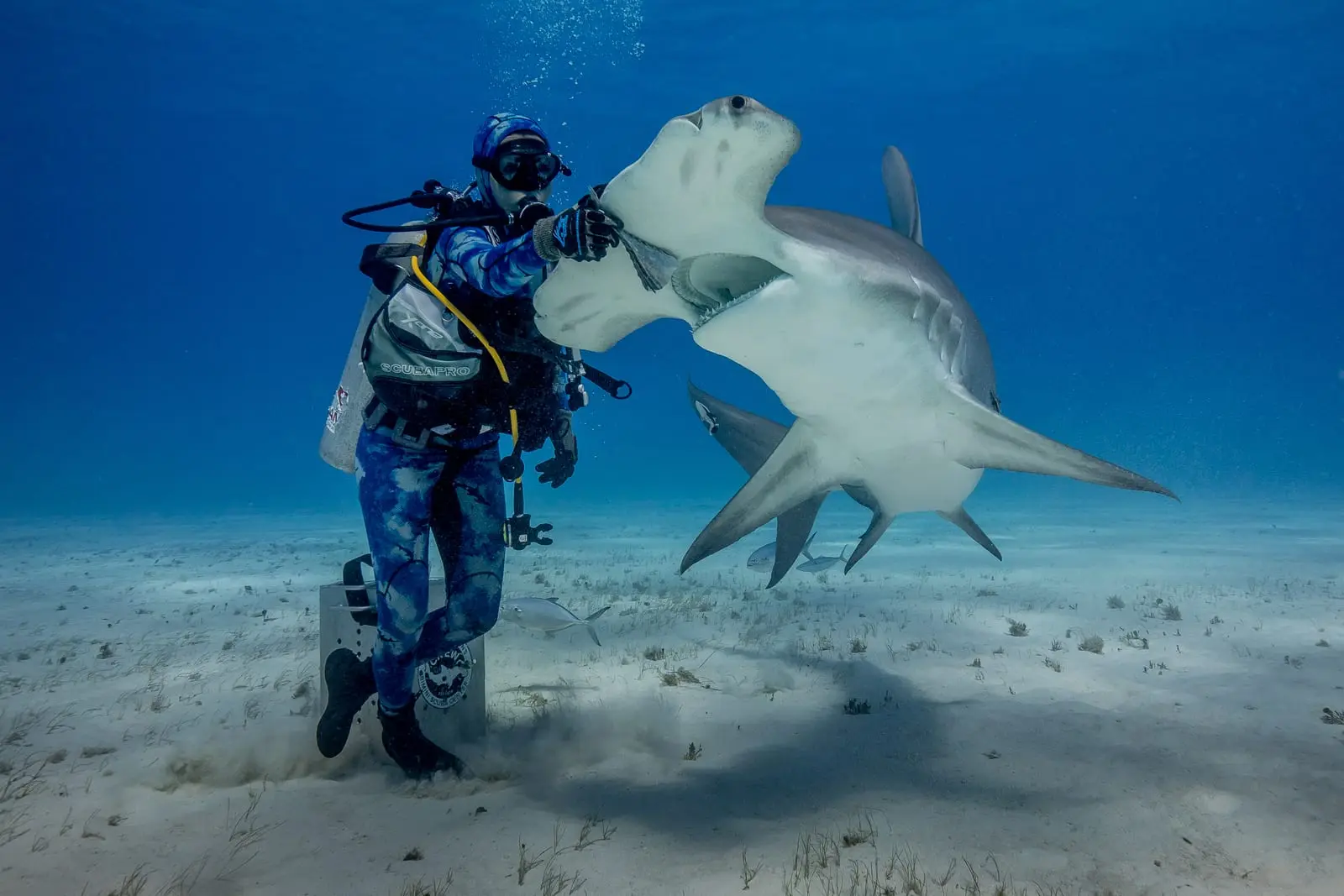
This is a boat-based, baited day trip from Bimini. Boats typically leave around midday and run into the late afternoon, and the whole day is spent at one site in five to seven metres, so a single tank can stretch past two hours. Crew put bait in the water, wait for hammerheads to settle, then send divers down to kneel in a line on the sand while a handler works the bait box. Open Water certification is enough — buoyancy and the discipline to stay put matter far more than a card. Bring real exposure protection: this is a northern Bahamian winter and you are motionless on sand for two hours, so a full 5 mm with hood and gloves is the baseline and 7 mm is not overkill.
What an encounter is like
The animals are large, mostly adult females between 2.7 and 3.7 metres, and they come close — a hammerhead working the bait box will pass within arm’s reach repeatedly, banking over the sand. Because the dive is shallow and stationary you get sustained time rather than a fleeting pass, and sharks that have visited before settle in and stay. Be honest about the trend, though: divers once saw up to ten individuals in a two-hour dive, and one or two on a typical day is now normal, with several long-recognised individuals not seen since 2020 and 2021. A single day trip can blank, so budget three or more diving days.
Frequently asked questions
- Is the Bimini hammerhead dive baited?
- Yes, openly. Bait goes in the water and divers enter once the sharks are on it — provisioning has run every winter at this site since 2012. There is no unbaited way to see this animal reliably, so the honest thing is to know you are taking part in it.
- Is feeding the sharks harmful?
- The published study of this exact site found bait is calorie-dense enough that most sharks taking it could meet their entire daily energy requirement from it, and that uptake rises with the number of boats present. Whether that displaces natural foraging is still an open question, and the researchers called for caps on vessel numbers and on how much bait is used.
- Why does a fed dive get recommended at all?
- Because the trade is real in both directions. Shark diving is a substantial part of the Bahamian economy and helped make the 2011 national shark sanctuary politically durable, and the partnership between operators and the Bimini Shark Lab produced the photo-ID catalogue and tracking work that we know this population from at all.
- How cold is it?
- Cooler than people expect. Winter water sits in the low-to-mid twenties Celsius and you spend two hours kneeling still on sand, so a full 5 mm suit with hood and gloves is the baseline and 7 mm is sensible if you run cold.
Sources
- Effects of Food Provisioning on the Daily Ration and Dive Site Use of Great Hammerhead Sharks, Sphyrna mokarran — Frontiers in Marine Science
- Conservation of Endangered Hammerheads — Bimini Biological Field Station
- The Missing Great Hammerheads of Bimini — Save Our Seas Foundation
- Great Hammerhead Safari — Neal Watson's Bimini Scuba Center