Animal profile
Where to see great white sharks
Carcharodon carcharias
Call everyone if you see it. Odds on a typical dive within its range — the right place and season are what beat them, which is what the destinations below are for.
VUVulnerable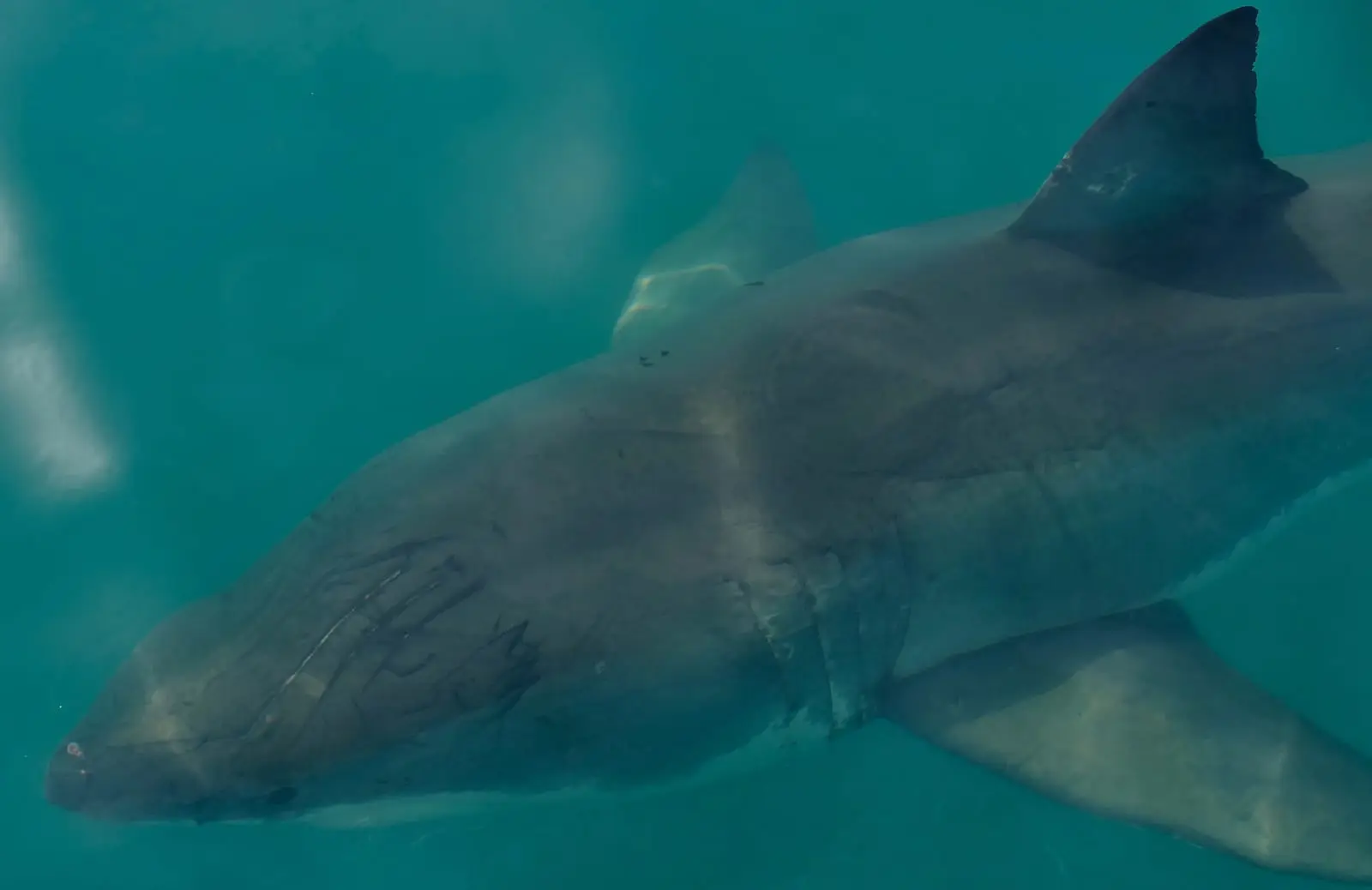
The white shark is the largest predatory fish in the ocean and the most recognisable animal in it, and almost everything divers believe about meeting one is wrong. It is not a tropical reef animal: it works cool, temperate water around seal and sea lion colonies, and it is thinly spread even there. No operator anywhere offers a dependable open-water dive with one, so every reliable encounter is a baited cage dive at a known aggregation site. It is also warm-bodied, keeping its muscles and gut above ambient temperature, which is what lets it hunt hard in cold water and cross whole oceans between colonies. Numbers are low enough that it is listed as Vulnerable, and the honest version of this dive is that you are visiting a small, protected population at a handful of places on the planet.
Size
The short version
Lifespan
~70 years
Solitary
usually met one at a time
Diet
Seals and sea lions above all, plus fish, rays, smaller sharks and whale carrion
Risk to youNeeds a briefed operator
Cage diving only; this is not a species to meet in open water by choice.
Risk from us
finning, shark control nets, bycatch — the last one is the part you control.
Planning the encounter
Depth
0–5 m in a surface cage
Recorded between 0 m and 30 m
Night diving
Daylight only
Odds through the day
Dawn
likely
Day
best time
Dusk
likely
Night
not seen
White sharks hunt hardest in the low light around dawn and dusk, but that is not what governs your odds here — cage operations run in daylight, and nobody puts a cage in the water at night. Treat the daytime peak as a fact about the boats rather than about the shark.
Best places to see great white sharks
How to identify a great white shark
- Nothing else looks like it: a heavy, conical snout, a sharply demarcated line where slate-grey upper body meets white belly, and a tall, near-symmetrical crescent tail rather than the long upper lobe most sharks have.
- Count the gill slits and look at the teeth — five very large gill slits, and broad, coarsely serrated triangular teeth visible even with the mouth closed. A mako, the usual confusion at a distance, is slimmer with a sharply pointed snout and narrow smooth-edged teeth.
- Look for the keel: a hard horizontal ridge either side of the tail base, shared with makos and porbeagles and absent in every requiem shark.
Meeting them responsibly
- Keep every part of you inside the cage. This sounds obvious right up until a shark passes close and a camera follows it out through the bars, which is how the very small number of cage injuries actually happen.
- Choose an operator that uses bait to attract rather than to feed, and does not tow bait across the cage. Rewarding an approach teaches an association that outlasts your trip and shapes how the animal behaves toward the next boat.
- Do not book a trip that promises you can get out of the cage. There is no legal or responsible free-swimming white shark dive at these sites, and an operator offering one is telling you what they think of the rules.
Frequently asked questions
- Where can you dive with great white sharks?
- The Neptune Islands off Port Lincoln in South Australia are the main option and the only cage-diving site in Australia, alongside Gansbaai and False Bay in South Africa. Guadalupe Island in Mexico, long the clearest-water white shark dive in the world, has been closed to shark-diving tourism, which removed what most people considered the best of them.
- Do I need to be a certified diver?
- No. Surface cages hang off the boat and are done on hookah with no certification at all, so a non-diver can do the standard trip. Certification only matters for the ocean-floor cages that some operators lower to the seabed.
- When is the best time to go?
- At the Neptune Islands they are present year-round but most reliable in the cooler months, with the largest females most often seen from about May to July. April to July is the usual recommendation, with December and January a good secondary window; the trade-off in winter is stronger wind and more cancellations.
Check me
The reference records behind this page on great white shark.