Animal profile
Where to see grey reef sharks
Carcharhinus amblyrhynchos
Frequent. Odds on a typical dive within its range — the right place and season are what beat them, which is what the destinations below are for.
ENEndangered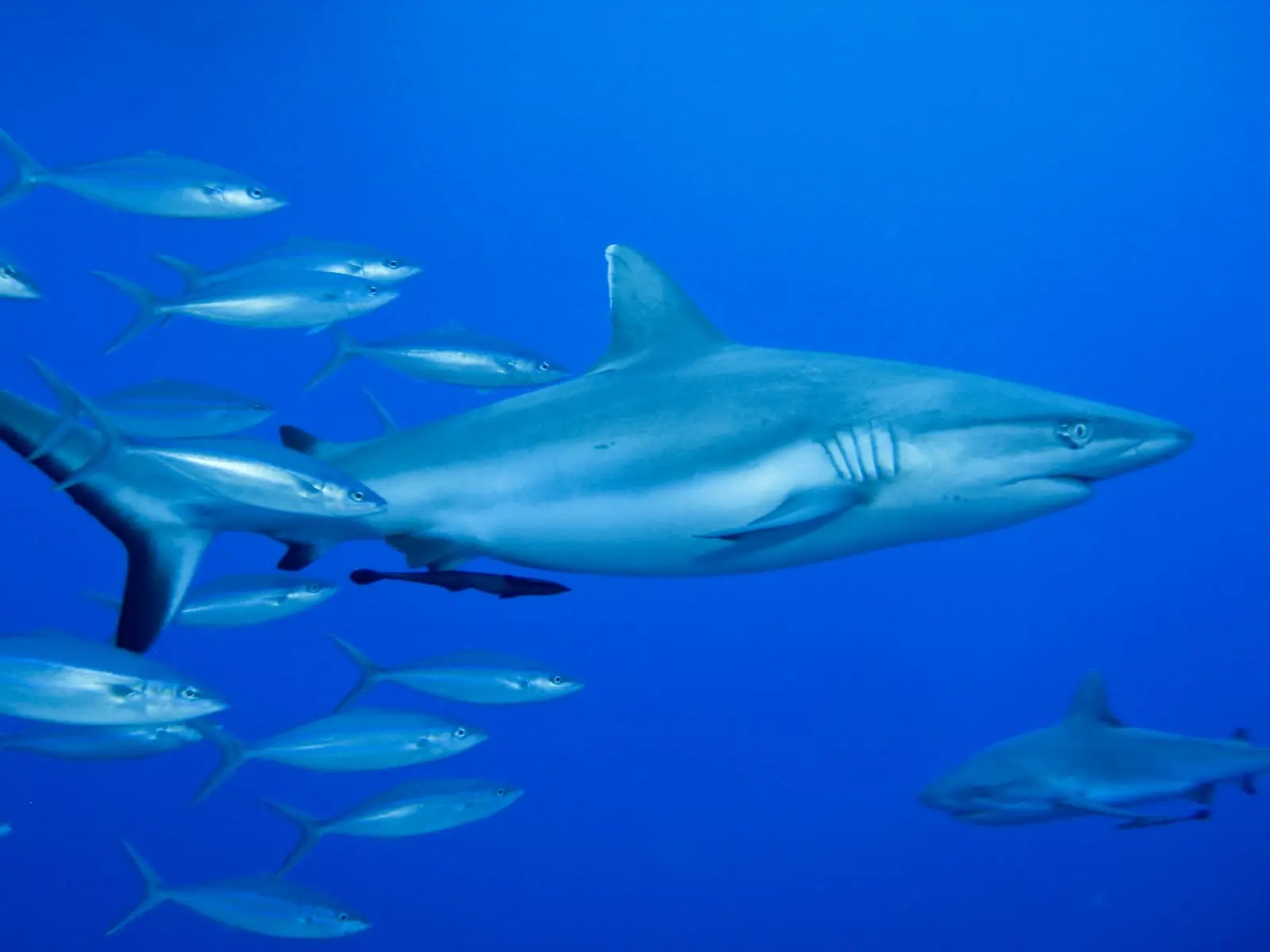
The grey reef shark is the shark most divers picture when they picture a reef. It holds station in current at the mouths of atoll channels and along outer-reef drop-offs across the Indo-Pacific, from East Africa to the central Pacific, and is conspicuously absent from the eastern Pacific. Bold and inquisitive by shark standards, it will swing in for a close look at a diver and then peel back into the blue. Where currents run hard and fishing pressure is low it gathers in dozens, which is why the best encounters are almost always channel dives on an incoming tide.
Size
The short version
Lifespan
~25 years
Schools
tens to hundreds when conditions line up
Diet
Reef fish, squid and octopus, and crustaceans
Risk to youLow
Gives a clear hunched threat display before anything else — back off and it ends.
Risk from us
finning, bycatch — the last one is the part you control.
Planning the encounter
Depth
15–30 m on reef fronts
Recorded between 0 m and 60 m
Night diving
Also seen on night dives
Odds through the day
Dawn
possible
Day
possible
Dusk
best time
Night
likely
Activity genuinely peaks at night — telemetry shows them foraging harder after dark and moving into shallower water. That is a fact about the shark rather than dive advice: almost everyone sees them by day on channel dives, because night diving in a strong-current pass is rarely offered and rarely wise.
Best places to see grey reef sharks
Well documented, and reliably seen in season.
Best time: Year-round with the right tide; January to April for the calmest, clearest water
Well documented, and reliably seen in season.
Best time: September to January, when the Coral Sea crossing is most reliable
Consistently reported, but a good way short of a sure thing.
Best time: April to June and September to November
How to identify a grey reef shark
- The tail is the tell: the entire rear margin of the caudal fin carries a broad solid black band, much wider than a tip. No other common reef shark has it.
- Not a blacktip reef shark — that species has a black-tipped first dorsal with a white line under it and patrols shallow lagoons and sand flats, while greys sit deeper on the reef front.
- Not a silvertip either — the silvertip is the photographic negative, with bright white trailing edges on dorsal, pectorals and tail, and a bulkier body. Black tail margin means grey reef; white fin margins mean silvertip.
Meeting them responsibly
- Learn the threat display. A grey reef that raises its snout, drops stiffened pectoral fins, arches its back and swims in an exaggerated side-to-side roll is telling you to back off — this is the best-documented agonistic display of any shark.
- If you get that display, withdraw smoothly and immediately. The documented pattern is that the display stops when the diver stops advancing, and escalates when the diver keeps coming.
- Never corner one against a reef, in a cave, or in a dead-end channel. Blocked escape is the single biggest escalator — leave it open water on at least one side and never swim between a shark and the blue.
Frequently asked questions
- Are grey reef sharks aggressive?
- They are bold and will approach divers closely, but attacks are rare and almost always follow a threat display that the diver ignored. Treat the hunched, stiff-finned posture as the warning it is, back off, and the encounter ends normally.
- Where is the best place to dive with grey reef sharks?
- Maldivian atoll channels are the most dependable, because hundreds of tidal passes act as shark highways. Osprey Reef in the Australian Coral Sea and the tidal passages around Kavieng in Papua New Guinea are the other two standouts.
- Do I need to be an experienced diver?
- For the good sites, yes. Grey reefs congregate where current runs, so the reliable dives are channel and drift dives with negative entries, reef hooks and a delayed surface marker buoy — not a first current dive.
Check me
The reference records behind this page on grey reef shark.