Animal profile
Where to see hammerhead sharks
Family Sphyrnidae
Rare enough to plan the trip around. Odds on a typical dive within its range — the right place and season are what beat them, which is what the destinations below are for.
Varies by species — scalloped and great hammerhead are Critically Endangered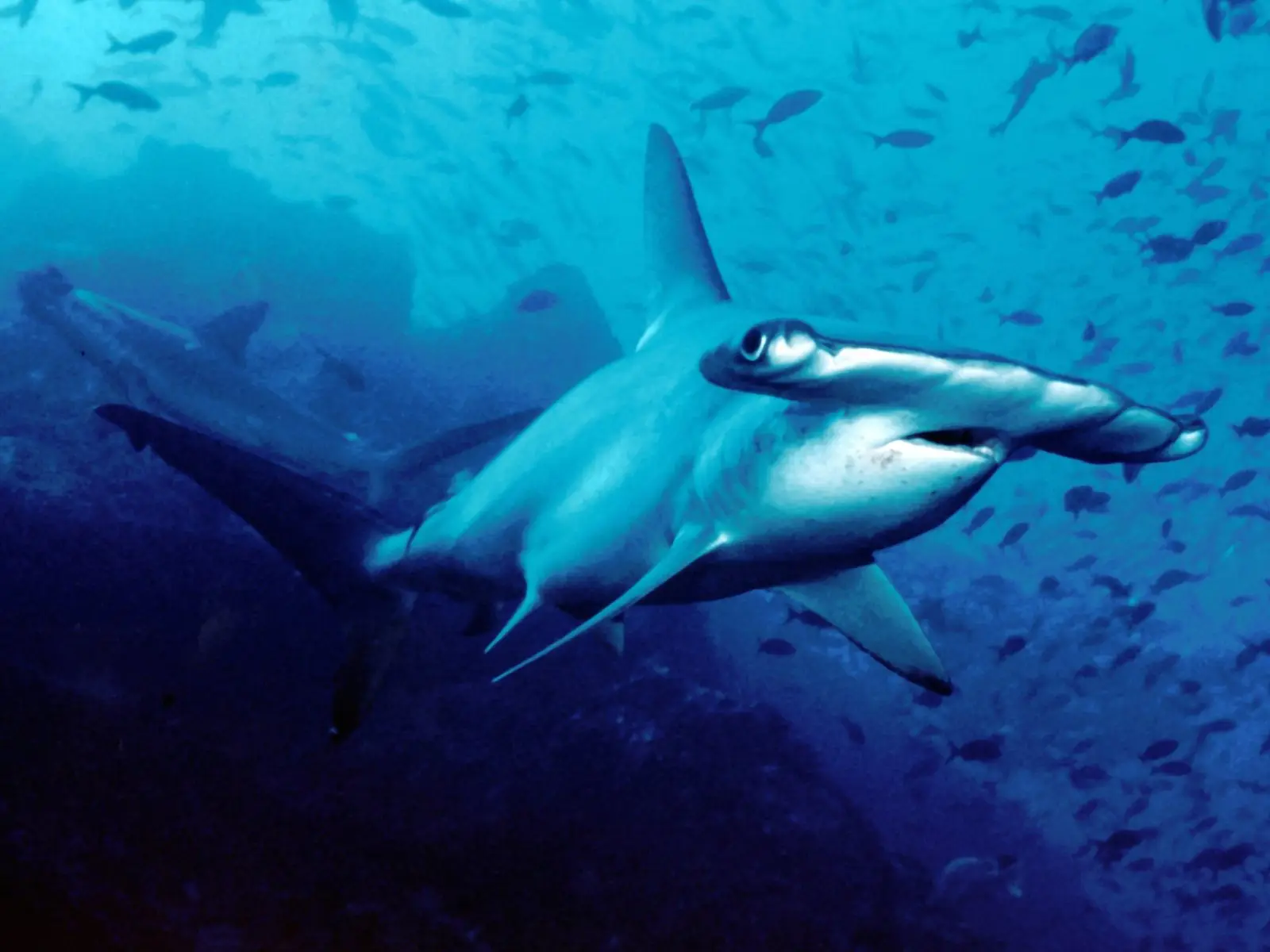
Hammerheads are the only sharks with a cephalofoil: the wide, flattened head that spreads their electro-sensory pores and nostrils across a broader sweep of seabed, widens their field of view, and works as a hydrofoil for tight turns and for pinning stingrays to the bottom. The family holds around ten species, but three matter to divers — the scalloped hammerhead (Sphyrna lewini), which forms the great daytime schools; the great hammerhead (Sphyrna mokarran), the solitary giant of the family; and the smooth hammerhead (Sphyrna zygaena). They span a wide size range, from the metre-and-a-half bonnethead to a great hammerhead well over five metres. Most are in trouble: prized for their large fins, the scalloped and the great are both listed as Critically Endangered, and the fin trade is the reason.
Size
The short version
Schools
tens to hundreds when conditions line up
Diet
Fish, rays and cephalopods — with a family habit of pinning stingrays against the bottom with the head
Risk to youLow
Shy of bubbles; incidents are very rare.
Risk from us
finning, bycatch — the last one is the part you control.
Planning the encounter
Depth
25–40 m for the schooling scalloped
Recorded between 15 m and 40 m
Night diving
Daylight only
Odds through the day
Dawn
best time
Day
possible
Dusk
unlikely
Night
not seen
Timing is really the scalloped's story: the schools hang deep in current at first light and thin as the day warms, so those dives are deep, early, and gas-planned. The great hammerhead keeps its own hours at baited sites.
Best places to see hammerhead sharks
How to identify a hammerhead shark
- Scalloped hammerhead: a wide head with a scalloped, notched front margin and a central indentation — the schooling species, and the one you meet at Galapagos or Yonaguni.
- Great hammerhead: much larger, with a nearly straight front margin and a very tall, sickle-shaped first dorsal fin. Almost always alone.
- Smooth hammerhead: a smoothly rounded front margin with no central notch — the 'smooth' is the absence of scallops.
Meeting them responsibly
- Keep your breathing quiet and your movements slow — hammerheads are skittish and bubble noise pushes a school away.
- Never chase or swim toward a school. Hold your depth and let them pass on their own terms.
- Hold your buoyancy off the rock at current-exposed sites; it is easy to crash into the reef while looking up at sharks.
Frequently asked questions
- How many kinds of hammerhead are there, and which do divers see?
- The family holds around ten species, but three matter underwater: the scalloped hammerhead, which forms the big schools; the great hammerhead, a solitary giant; and the smooth hammerhead. The scalloped is the one most hammerhead trips are built around.
- Which hammerhead is the one that schools?
- The scalloped hammerhead. It gathers in daytime aggregations of tens to hundreds around seamounts and offshore pinnacles — Darwin and Wolf in the Galapagos, and Yonaguni in Okinawa, are the classic sites. The great hammerhead, by contrast, is almost always seen alone.
- Are hammerheads endangered?
- Several are. The scalloped and great hammerheads are both listed as Critically Endangered by the IUCN, driven mainly by the fin trade; the smooth hammerhead is Vulnerable. Their habit of gathering in predictable places is part of what makes them so easy to overfish.
Check me
The reference records behind this page on hammerhead shark.