Animal profile
Where to see mola mola
Mola alexandrini
Rare enough to plan the trip around. Odds on a typical dive within its range — the right place and season are what beat them, which is what the destinations below are for.
Mola alexandrini not separately assessed; Mola mola is Vulnerable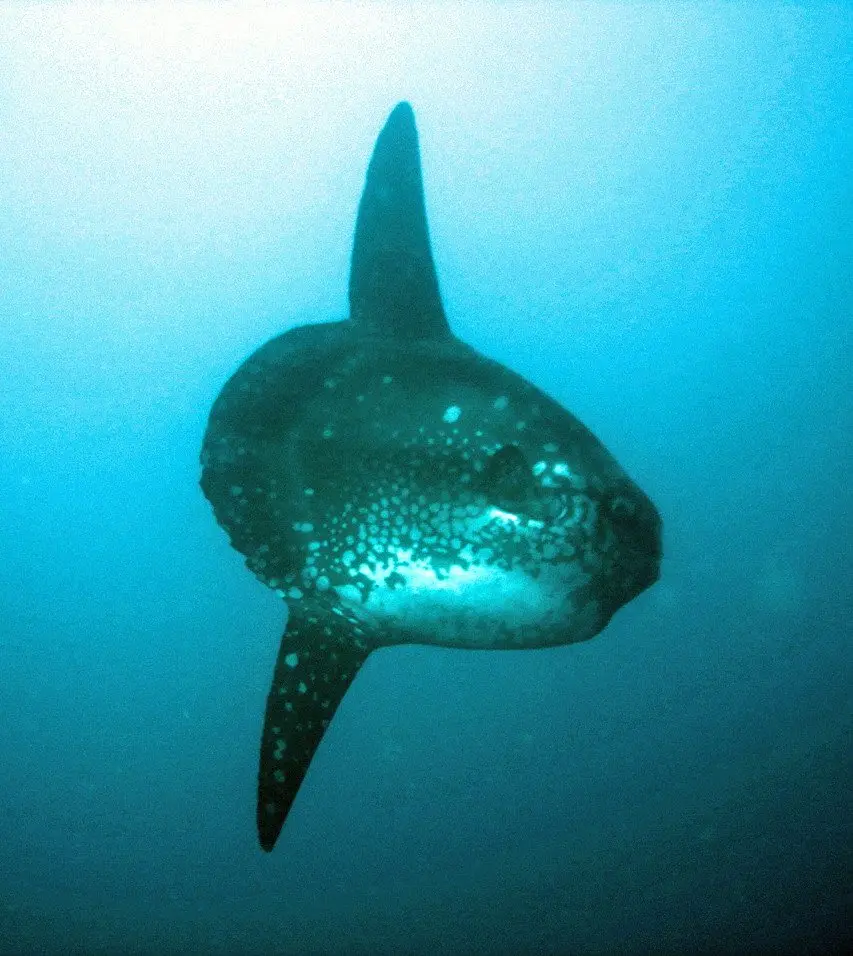
The sunfish seen off Nusa Penida is Mola alexandrini, the bumphead sunfish — a huge, flattened, nearly tailless animal with a small beak-like mouth and a rudder-shaped clavus where a tail fin would be. Almost everyone calls it a mola mola, but genetic work published in 2017 established that the true ocean sunfish, Mola mola, is a separate species. It normally lives deep, diving beyond 600 meters to hunt jellyfish and salps, then rising to warm up between dives. From roughly July to October, cold upwelling along Bali's ocean-facing coast draws it up to shallow cleaning stations, where reef fish pick parasites from its skin — the brief window in which divers can meet it.
Size
The short version
Solitary
usually met one at a time
Diet
Mainly jellyfish and salps
Risk to youHarmless
Harmless and slow; it leaves if you approach the cleaning station.
Risk from us
bycatch, crowding at cleaning stations — the last one is the part you control.
Planning the encounter
Depth
15–30 m
Recorded between 10 m and 40 m
Night diving
Daylight only
Odds through the day
Dawn
possible
Day
likely
Dusk
unlikely
Night
not seen
Molas rise to reef cleaning stations from cold water below. The thermocline that brings them is a daytime upwelling — and cold enough that most divers want a 5 mm.
Best places to see mola mola
How to identify a mola mola
- An enormous flattened, near-circular body with no true tail — just a rudder-like clavus behind tall dorsal and anal fins.
- A small, fused beak-like mouth, and in this species a distinct bump on the head that separates it from the true Mola mola.
- Usually hanging motionless at an angle over a reef being cleaned, rather than swimming actively.
Meeting them responsibly
- Do not chase, block or touch. These are deep-water animals and they spook off a cleaning station easily.
- Approach slowly and stay low, keeping a respectful distance rather than swimming straight at it.
- No flash. A startled sunfish leaves before it has been fully cleaned.
Frequently asked questions
- Where can I see mola mola?
- Crystal Bay off Nusa Penida in Bali is the most accessible place in the world to meet one, on the cleaning station past the bay's Second Corner. It is demanding diving with serious downcurrents.
- When is mola mola season?
- July to October, peaking August–September, when cold upwelling along Bali's ocean-facing coast brings them up from deep water to cleaning stations around 20–30 meters.
- How big do mola mola get?
- Up to about 3.3 meters and 2,300 kg, which makes them the heaviest bony fish in the ocean. The animal seen in Bali is Mola alexandrini, the bumphead sunfish, rather than the true Mola mola.
Check me
The reference records behind this page on mola mola.