Animal profile
Where to see oceanic whitetip sharks
Carcharhinus longimanus
Call everyone if you see it. Odds on a typical dive within its range — the right place and season are what beat them, which is what the destinations below are for.
CRCritically Endangered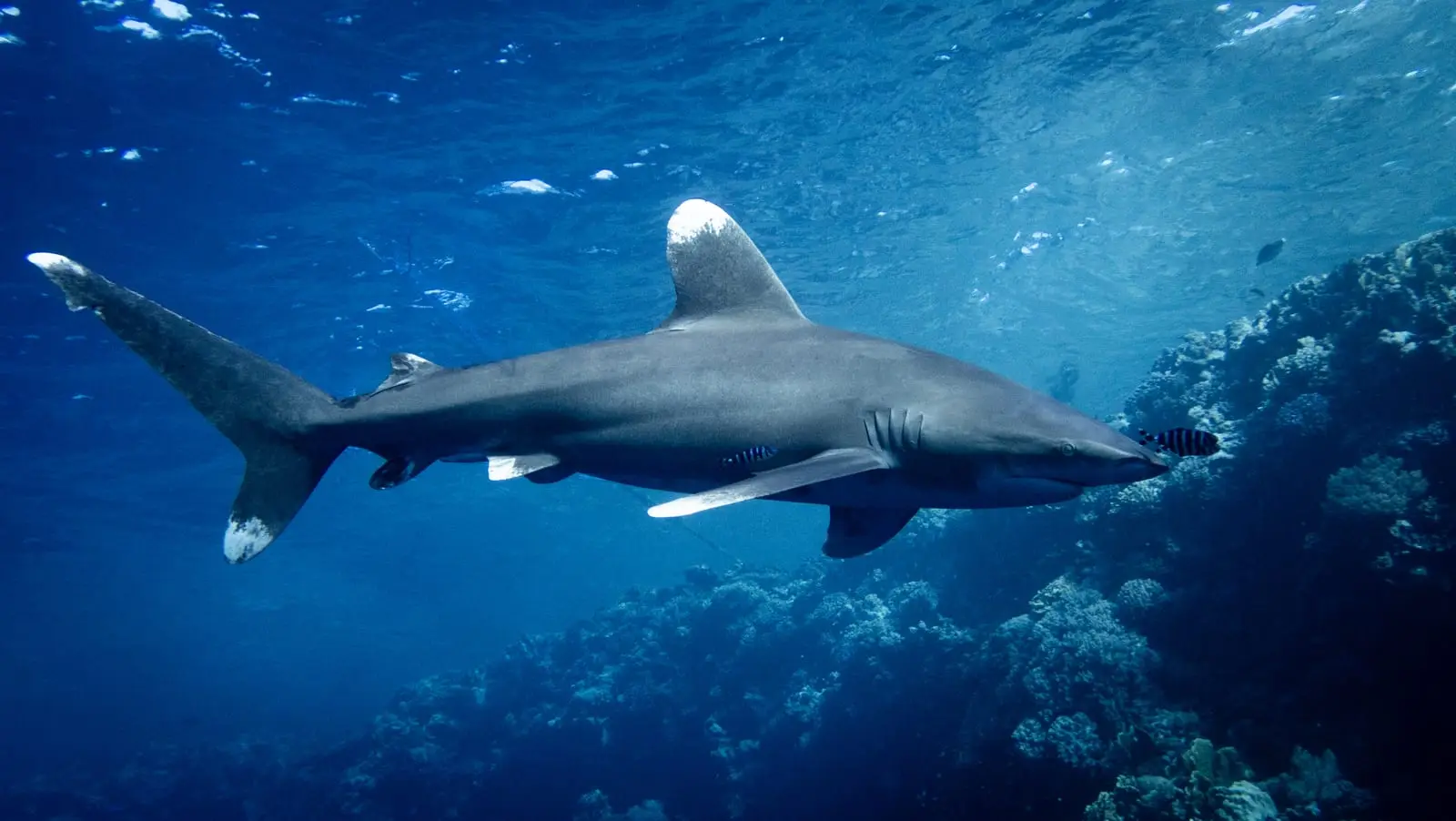
The oceanic whitetip was once thought to be one of the most abundant large animals on the planet, a shark of the open ocean found across every tropical sea. Overfishing, largely as bycatch in tuna and swordfish longlines, has cut it by an order of magnitude, and it is now listed as Critically Endangered. It is built for a life with no seabed: enormous rounded pectoral fins like wings, a leisurely cruise it can hold indefinitely, and a bold, unhurried curiosity toward anything new in its water. That curiosity is why encounters with it are so different from reef diving — it approaches, and it keeps approaching, in water thousands of metres deep. Because it lives nowhere in particular, there is almost nowhere to reliably find it; Cat Island in the Bahamas, where the sharks follow the spring tuna migration, is the exception the whole diving world uses.
Size
The short version
Lifespan
~22 years
Solitary
usually met one at a time
Diet
Tuna and other open-ocean fish, squid, and occasionally turtles and seabirds
Risk to youNeeds a briefed operator
Persistent and unafraid in open blue water; keep it in sight and stay vertical in a group.
Risk from us
finning, bycatch, baiting — the last one is the part you control.
Planning the encounter
Depth
5–15 m in blue water
Recorded between 0 m and 230 m
Night diving
Daylight only
Odds through the day
Dawn
possible
Day
best time
Dusk
possible
Night
not seen
An epipelagic shark that spends its days in the warm surface layer, which is where the diving happens. Blue-water dives over open ocean run in full daylight for visibility and safety reasons, so there is no night-diving version of this encounter at all.
Best places to see oceanic whitetip sharks
How to identify a oceanic whitetip shark
- The fins name the animal: very long, broad, rounded-tipped pectorals and a huge rounded first dorsal, all mottled with dirty-white tips. Nothing else in blue water carries fins that shape.
- The white tips are irregular and smudged, not the crisp painted markings of a whitetip reef shark — which is a small, slender, bottom-dwelling animal that lives on reefs and will never be beside you in open ocean.
- Watch how it moves. A slow, wing-like cruise with pilot fish and often a dorado escort in tow, closing steadily rather than passing by, is the behavioural signature.
Meeting them responsibly
- Keep your head on a swivel and stay vertical, facing the animal. This is a bold shark that will approach from behind if you let it, and calm awareness — not retreat — is what keeps the encounter at arm’s length.
- Do not push off its nose or slap the water, and never turn and swim away. Redirect firmly with a flat hand or a camera housing if it gets too close, and keep the group tight with the boat where you were briefed to keep it.
- Photograph the dorsal fin and scarring and pass it to a shark ID catalogue. Individuals are recognisable, the population is Critically Endangered, and a photo from a dive is genuinely useful data.
Frequently asked questions
- Where can you dive with oceanic whitetips?
- Cat Island in the Bahamas is the one dependable place in the world, in April and May when the sharks follow the tuna migration. Elphinstone and the offshore reefs of the Egyptian Red Sea produce them too, but as a chance encounter rather than a plan.
- Are oceanic whitetips dangerous?
- They are bold and inquisitive in a way reef sharks are not, and their historical reputation comes from open-ocean shipwreck and air-disaster survivors rather than from divers. On organised blue-water dives with a proper briefing the record is good, but this is a dive that demands you stay alert and keep your position rather than drift and sightsee.
- What is the dive actually like?
- You are in open ocean with several thousand metres of water beneath you, usually tethered near the boat with a bait box hung at about ten metres to keep the sharks shallow. There is no reef, no bottom and no reference — just blue, and animals that come to look at you.
Check me
The reference records behind this page on oceanic whitetip shark.