Animal profile
Where to see pelagic thresher sharks
Alopias pelagicus
Call everyone if you see it. Odds on a typical dive within its range — the right place and season are what beat them, which is what the destinations below are for.
ENEndangered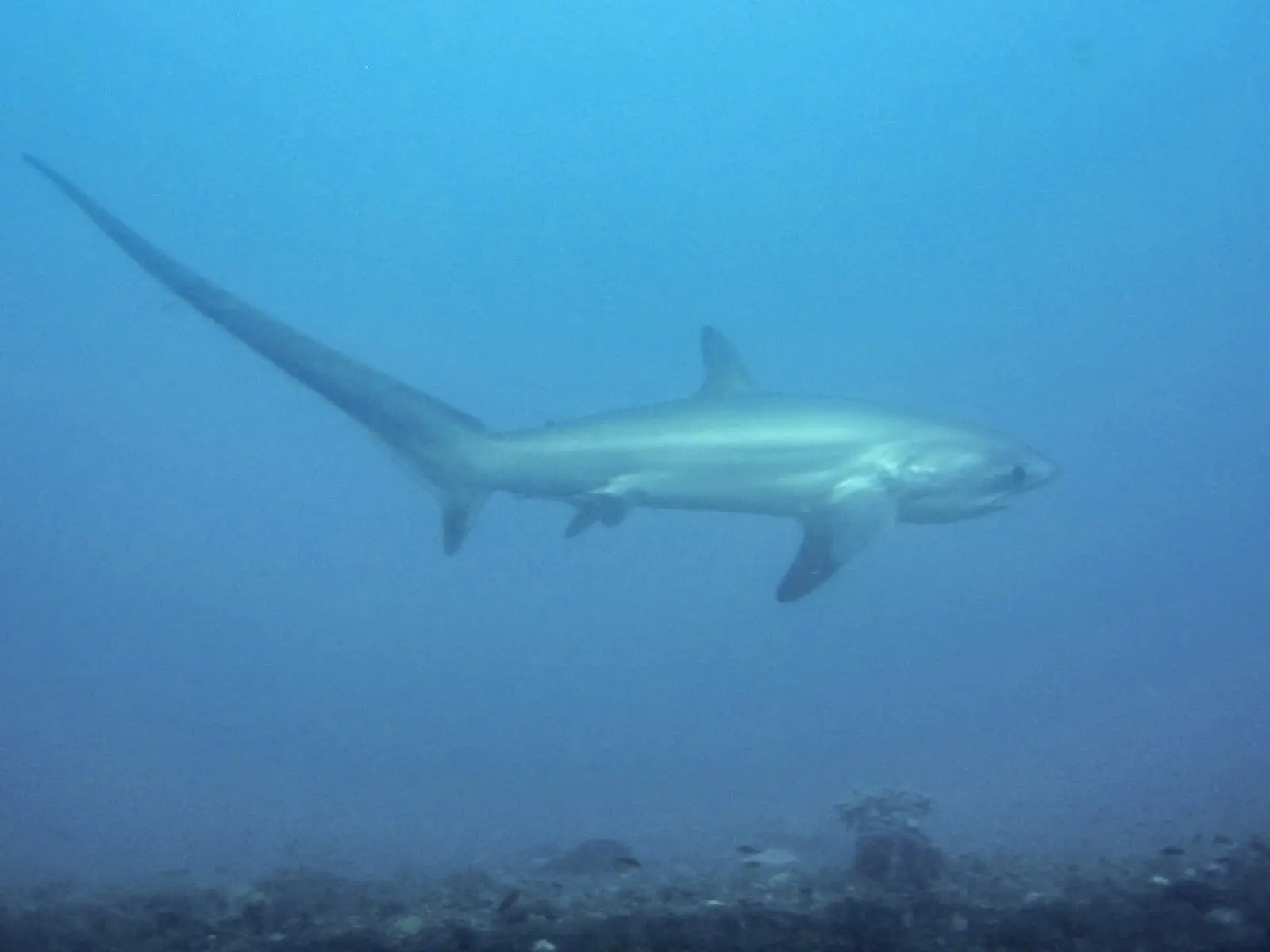
The pelagic thresher is a slim, big-eyed open-ocean shark whose upper tail lobe is as long as the rest of its body. It uses that tail as a weapon: it herds sardines into a ball and cracks the tail overhead fast enough to stun several fish at once, one of very few documented cases of a shark using something other than its jaws to kill. Divers meet it not out in the blue but at shallow seamount cleaning stations, where it queues at dawn to have parasites picked off by wrasse. Those cleaning visits are the entire reason a deep-water species is diveable at all, and they are dependable in exactly one place on earth.
Size
The short version
Lifespan
~28 years
Solitary
usually met one at a time
Diet
Small schooling fish and squid, stunned with the tail
Risk to youHarmless
Timid; leaves at the first flash or fast approach.
Risk from us
bycatch, finning, flash photography at cleaning stations — the last one is the part you control.
Planning the encounter
Depth
14–25 m at cleaning stations
Recorded between 10 m and 300 m
Night diving
Daylight only
Odds through the day
Dawn
best time
Day
unlikely
Dusk
unlikely
Night
not seen
Overwhelmingly a dawn animal from a diver’s point of view. Pelagic threshers spend their nights and most of their days in deep offshore water, rising to shallow cleaning stations around first light when the wrasse are working and the shallows are still dim. Since the sharks moved to shallower Kimud Shoal the window has widened into the morning, but the first hour of light remains far and away the best odds.
Best places to see pelagic thresher sharks
Well documented, and reliably seen in season.
Best time: Year-round; December to July for the calmest crossing
Best time: No reliable thresher season; occasional sightings year-round
How to identify a pelagic thresher shark
- Not a bigeye thresher: the bigeye has an enormous eye set in a keyhole socket that extends onto the top of the skull, plus deep grooves on the nape. If the eye looks like it is aimed upward, it is a bigeye.
- Not a common thresher: the common has a white patch wrapping up from the belly over the pectoral fin base, while the pelagic thresher is dark over the same spot. Dark shoulder means pelagic.
- The first dorsal sits about midway along the back, its free rear tip well ahead of the pelvic fins — on a bigeye it is set noticeably further back.
Meeting them responsibly
- No flash, no strobes, ever. Cleaning stations work because the shark feels safe enough to slow down; one strobe and it leaves, taking the rest of the group’s encounter with it.
- Stay low, stay put, and let the shark close the distance. Threshers approach divers who hold still and abandon the station when divers spread out or swim toward them.
- Fin control is conservation here. The cleaner wrasse colonies on those coral heads are the reason the sharks come at all, so hover — no hands on the reef, no kneeling, no scooters.
Frequently asked questions
- Where can I dive with thresher sharks?
- Malapascua in the northern Philippines is the only place where they are a near-daily certainty. The dive is at Kimud Shoal, which the sharks moved to around 2022 after tiger sharks settled on the original site at Monad Shoal.
- Why do thresher shark dives start before dawn?
- Because the sharks come up from deep water to seamount cleaning stations in the hours around first light, when the cleaner wrasse are active. Boats leave Malapascua at 04:30–05:30 to put divers on the plateau at sunrise.
- How does a thresher shark use its tail?
- It herds small fish into a tight ball, then whips the upper tail lobe forward over its own head like a whip crack, stunning several at once. Filmed studies in the Philippines recorded tail-tip speeds above 20 metres per second.
Check me
The reference records behind this page on pelagic thresher shark.