Animal profile
Where to see port jackson sharks
Heterodontus portusjacksoni
Frequent. Odds on a typical dive within its range — the right place and season are what beat them, which is what the destinations below are for.
LCLeast Concern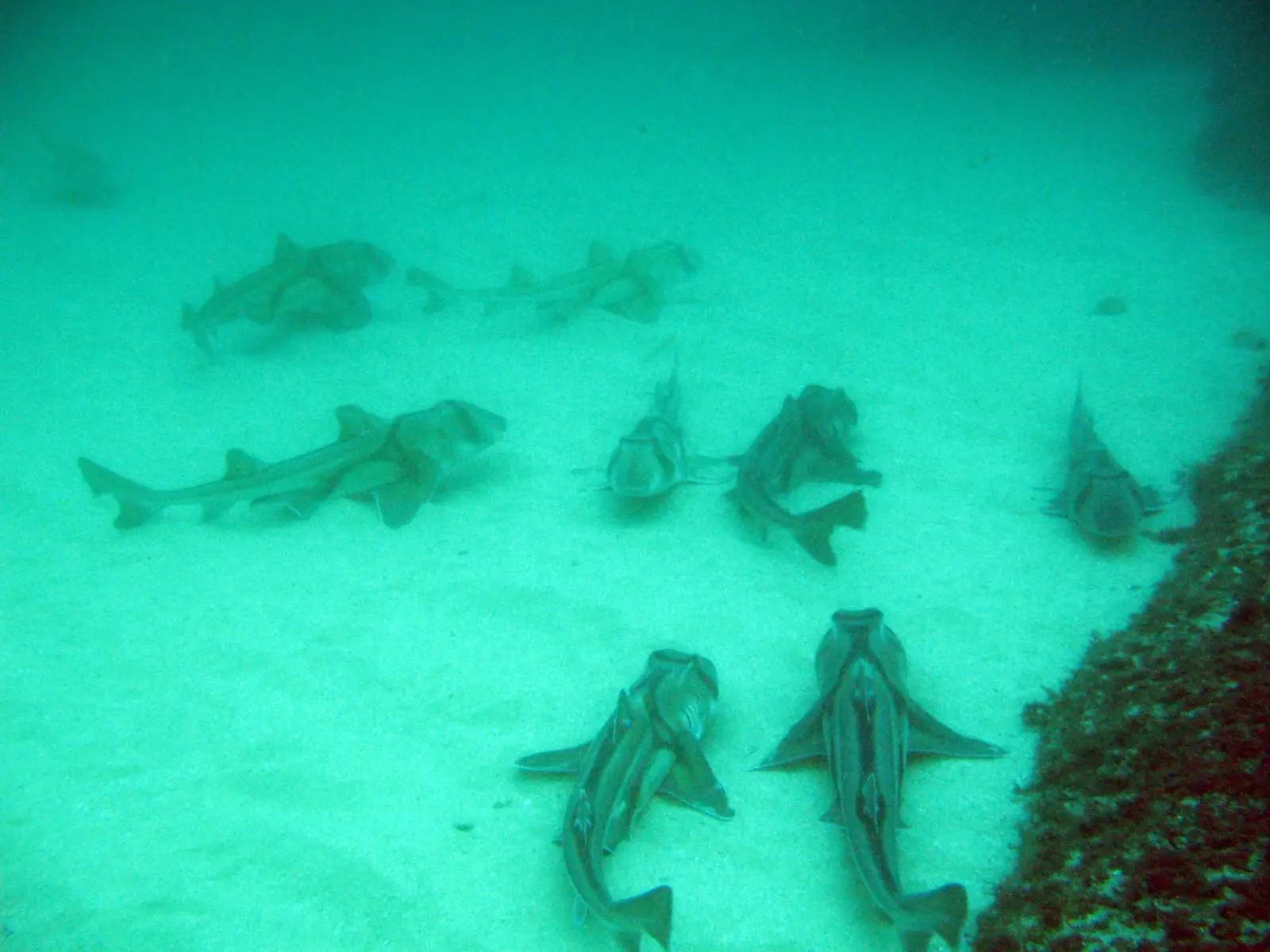
The Port Jackson shark is a temperate Australian bullhead shark, and it looks nothing like the sharks most divers picture: a heavy blunt head with a pig-like snout, a raised crest over each eye, a sharp spine at the front of both dorsal fins, and a dark harness-shaped marking that loops over the shoulders and down the flanks. Its teeth match its diet rather than its reputation — small pointed teeth at the front and broad flat crushing plates at the back, for grinding up urchins, molluscs and crabs. It is nocturnal and slow, spending days piled under ledges and in rocky gutters, and it migrates: animals move into the New South Wales shallows through autumn and gather to breed in late winter and early spring, which is why a Sydney shore dive in August can put several in one gutter. The females wedge a spiral, screw-shaped egg case into rock crevices, which is one of the more remarkable things to find on a temperate dive.
Size
The short version
Lifespan
~30 years
Seasonal aggregations
many together at the right time of year
Diet
Urchins, molluscs, crabs and worms, crushed with flattened rear teeth
Risk to youHarmless
Harmless; crushing plates for shellfish, not a biting shark.
Risk from us
handling, disturbing winter aggregations — the last one is the part you control.
Planning the encounter
Depth
5–20 m in rocky gutters and under ledges
Recorded between 1 m and 275 m
Night diving
Better on a night dive
Odds through the day
Dawn
possible
Day
likely
Dusk
likely
Night
best time
Easy to find by day and much more interesting after dark. Daylight dives turn them up resting in gutters and under ledges, often several together; at night they are out on the sand and rubble crushing shellfish. Season matters more than time of day here — a Sydney winter night dive is the peak of both axes.
Best places to see port jackson sharks
How to identify a port jackson shark
- The harness is the giveaway: a dark band running over the head and across each shoulder, then sweeping down the flanks like a saddle strap on a pale grey-brown body.
- Check the head and fins — a bluntly rounded, almost pig-like snout with a pronounced crest above each eye, and a stout spine at the leading edge of both dorsal fins. No other shark on a Sydney dive has either.
- Its close relative the crested horn shark shares the shape but has much larger crests and blotchy, non-harness markings. If the pattern reads as straps rather than blotches, it is a Port Jackson.
Meeting them responsibly
- Look, do not lift. They are docile and easy to pick up, which is why they get handled constantly on Sydney shore dives; the dorsal spines are defensive and handling costs the animal its resting spot.
- Leave the egg cases alone. The spiral cases are deliberately screwed into crevices by the female, and pulling one out to photograph it usually kills the embryo inside.
- Give resting groups space and mind your fins in the gutters. Winter aggregations mean several animals in one narrow ledge, and a careless fin stroke in a surge-swept gutter does the damage.
Frequently asked questions
- Where can I see a Port Jackson shark?
- Temperate southern Australia, and Sydney is the easiest place in the world for it. Shelly Beach in Cabbage Tree Bay, Gordons Bay, Bare Island and The Steps at Kurnell all hold them under ledges through the colder months, and Jervis Bay is one of only a few known breeding aggregation sites on the New South Wales coast.
- When is the season?
- Winter and early spring. They move into the New South Wales shallows from about April and gather to breed from roughly July to October, with August and September the peak at Jervis Bay. In summer they largely disperse to deeper and more southerly water.
- Are they dangerous?
- No. They are small, slow, nocturnal shellfish crushers that ignore divers entirely. The only things to respect are the two dorsal spines, which are purely defensive, and that is an argument for not picking one up.
Check me
The reference records behind this page on port jackson shark.