Animal profile
Where to see sea turtles
Chelonia mydas (green turtle) & Eretmochelys imbricata (hawksbill)
Almost guaranteed. Odds on a typical dive within its range — the right place and season are what beat them, which is what the destinations below are for.
Green turtle Endangered; hawksbill Critically Endangered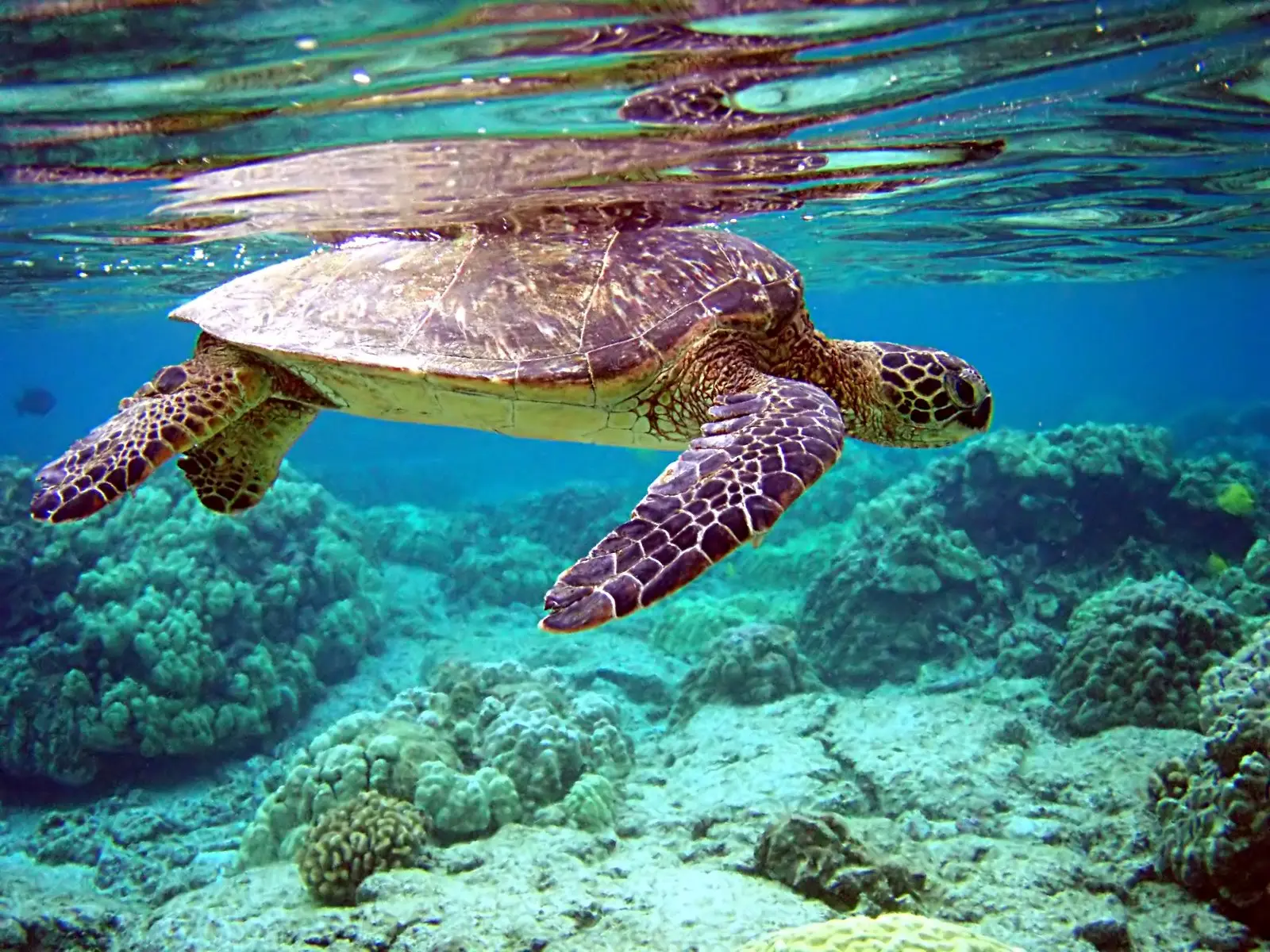
Green sea turtles are long-lived marine reptiles that travel hundreds of kilometres between the reefs where they feed and the beaches where they nest, using natal homing to return to the region they hatched in. In Hawaii they do something seen almost nowhere else at this frequency: bask out of the water on sand and lava rock, most likely to regulate temperature, save energy and rest out of reach of tiger sharks. The population has recovered substantially since legal protection arrived in the 1970s, from roughly 67 nesting females recorded in 1973 to close to 500 nesting annually in recent surveys — one of conservation's genuine success stories.
Size
The short version
Solitary
usually met one at a time
Diet
Adult green turtles graze seagrass and algae; hawksbills eat mainly sponges
Risk to youLow
Only if cornered or fed — a beak that crushes shellfish.
Risk from us
riding or touching, boat strike, plastic, egg harvest — the last one is the part you control.
Planning the encounter
Depth
5–20 m
Recorded between 1 m and 30 m
Night diving
Also seen on night dives
Odds through the day
Dawn
possible
Day
likely
Dusk
possible
Night
possible
Grazing and reef traffic peak in daylight. On a night dive you find them wedged under ledges asleep — a different and much calmer encounter.
Best places to see sea turtles
How to identify a sea turtle
- Green turtles have a small rounded head and a blunt, serrated beak; hawksbills have a narrow head with a pointed, hawk-like beak.
- Hawksbill shells have overlapping tortoiseshell scutes and a serrated rear edge; a green turtle's are smoother and don't overlap.
- Around most reefs the green turtle is the one you'll meet — a hawksbill is a genuinely notable sighting.
Meeting them responsibly
- Keep at least 3 meters (10 feet) away, in the water and on the beach. Give a turtle resting on sand considerably more room than that.
- Never touch, chase, feed or ride one. In Hawaii this is illegal under the Endangered Species Act, not merely rude, and people have been fined.
- Never block a turtle's path to the surface. They breathe air, and a turtle repeatedly prevented from surfacing can drown.
Frequently asked questions
- Where can I see sea turtles?
- Hawaii is the most reliable place to meet one: Laniakea Beach on Oahu, Kahalu'u Beach Park on the Big Island and Black Rock on Maui all have resident honu, reachable by walking in from the beach.
- Can you touch a sea turtle?
- No. In Hawaii, touching, chasing or feeding a honu is illegal under the federal Endangered Species Act and state law — NOAA documented a snorkeller paying a $1,500 settlement after pursuing one off Kaua'i. Stay 3 meters (10 feet) back.
- How long do sea turtles live?
- Green turtles don't reach breeding age until 20 to 30 years old and are believed to live several decades beyond that. Their exact maximum lifespan in the wild isn't precisely established.
Check me
The reference records behind this page on sea turtle.