Animal profile
Where to see tawny nurse sharks
Nebrius ferrugineus
Regular, but it has to want to be seen. Odds on a typical dive within its range — the right place and season are what beat them, which is what the destinations below are for.
VUVulnerable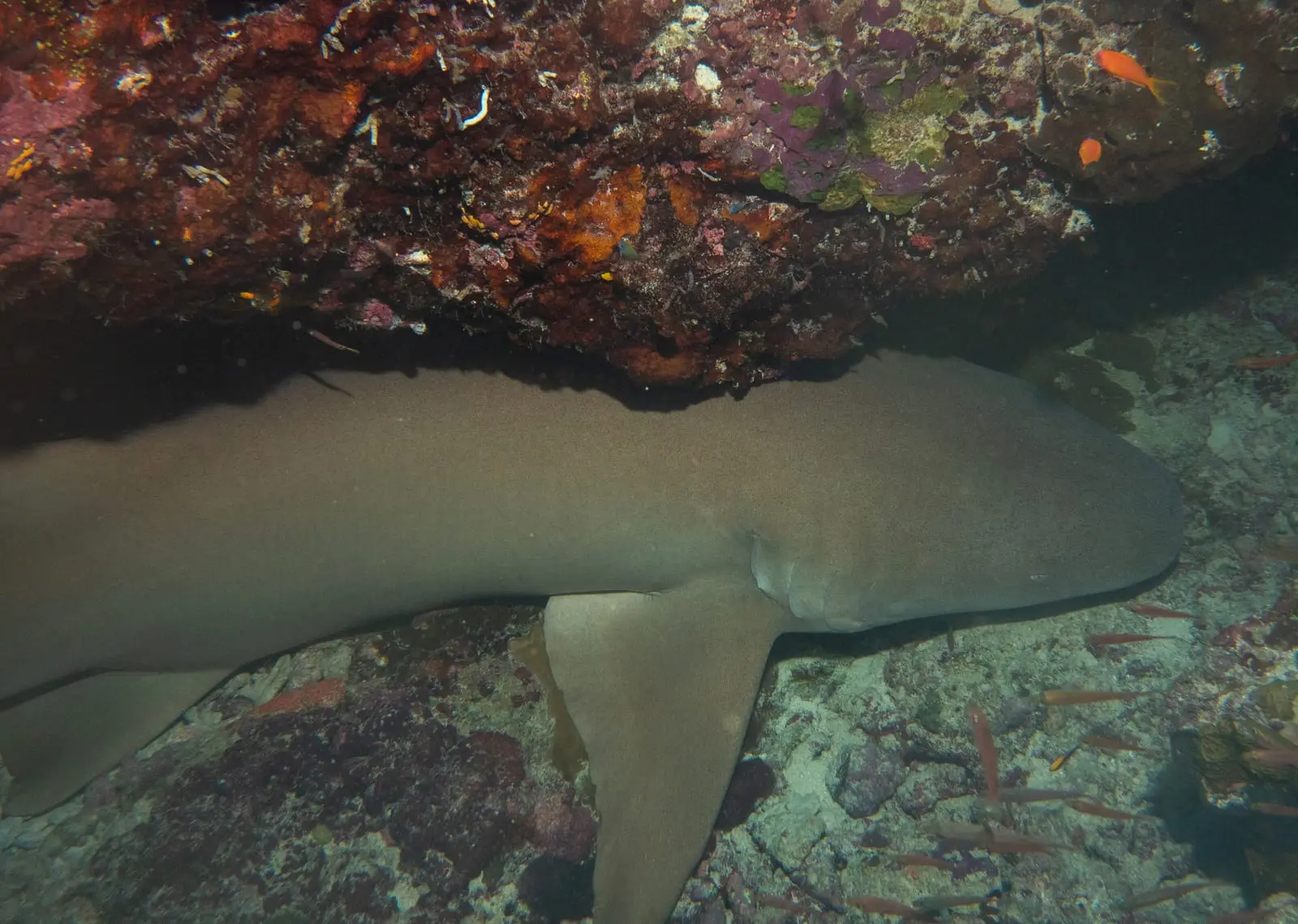
The tawny nurse shark is the Indo-Pacific counterpart to the Caribbean nurse shark, and it lives the same double life: heavy and inert through the day, wedged under coral bommies and ledges and often stacked in groups, then an active, powerful predator after dark. Its feeding is the remarkable part. It hunts by suction, sealing its small mouth over a hole in the reef and generating enough negative pressure to pull an octopus or a sleeping fish straight out of cover — an audible, visible technique that is one of the better things to watch on a night dive. It is large, to well over three metres, and almost entirely indifferent to divers. It is also in trouble across much of its range from inshore fisheries, and listed as Vulnerable, which sits awkwardly beside the handful of sites that feed it for tourism.
Size
The short version
Small groups
a handful in the same spot
Diet
Octopus, reef fish, crustaceans and urchins, extracted from holes by suction
Risk to youModerate
Placid while resting; grabbing one provokes a strong suction bite.
Risk from us
touching, targeted fishing, disturbing resting aggregations — the last one is the part you control.
Planning the encounter
Depth
5–30 m on reef
Recorded between 1 m and 70 m
Night diving
Better on a night dive
Odds through the day
Dawn
possible
Day
likely
Dusk
likely
Night
best time
Easy to find asleep by day and worth staying up for at night. The suction feeding is the reason to book a night dive: the shark noses along the reef, seals its mouth over a crevice, and pulls prey out with a pull you can sometimes hear through the water.
Best places to see tawny nurse sharks
How to identify a tawny nurse shark
- Look for a broad flat head with small eyes, two short barbels on the upper lip, and a plain tawny to grey-brown body with no pattern — a shape unmistakably built for lying on the bottom.
- The dorsal fins are angular and set well back, and the tail has a long upper lobe with almost no lower one. Its Caribbean cousin looks similar, but the two species do not overlap: tawny is Indo-Pacific, Ginglymostoma cirratum is Atlantic.
- Do not confuse it with a wobbegong, which shares the resting habit but is flattened, heavily patterned and fringed with skin flaps around the mouth. The tawny nurse is round-bodied and plain.
Meeting them responsibly
- Do not touch, ride or pull a tail. It is calm to the point of looking inert, which is why it gets handled, and a provoked bite from a suction-and-grip jaw is very hard to release.
- Leave resting animals in their bommies. Groups return to the same shelters, and repeatedly disturbed sites get abandoned — you are trading tomorrow’s sighting for today’s photograph.
- Think about whether you want to dive a fed site. Some well-known Indian Ocean night dives concentrate large numbers by feeding them, which reliably produces the spectacle and just as reliably produces crowding, jostling animals and habituated behaviour. A reef night dive shows you the same species hunting properly.
Frequently asked questions
- Where can I see tawny nurse sharks?
- Widely across the Indo-Pacific, from the Red Sea to Australia. In the Maldives they are common and easily found, and the Alimatha jetty night dive in Vaavu Atoll is the famous one, where large numbers gather — a fed site, and worth knowing that before you go. Thailand and the Solomon Islands are also known for them.
- Is it the same as a Caribbean nurse shark?
- No, though the habits are nearly identical. This is Nebrius ferrugineus of the Indo-Pacific; the Caribbean animal is Ginglymostoma cirratum. Their ranges do not overlap, so geography settles the identification for you.
- Are they dangerous?
- Not unprovoked. They ignore divers and spend most of the daylight hours asleep. The bites on record come from handling, spearfishing situations and fed dives where animals crowd and jostle for food, which is a good argument for keeping your hands in and choosing your sites.
Check me
The reference records behind this page on tawny nurse shark.