Kimud Shoal & Monad Shoal, Malapascua, Cebu
Where to see thresher sharks in the Philippines
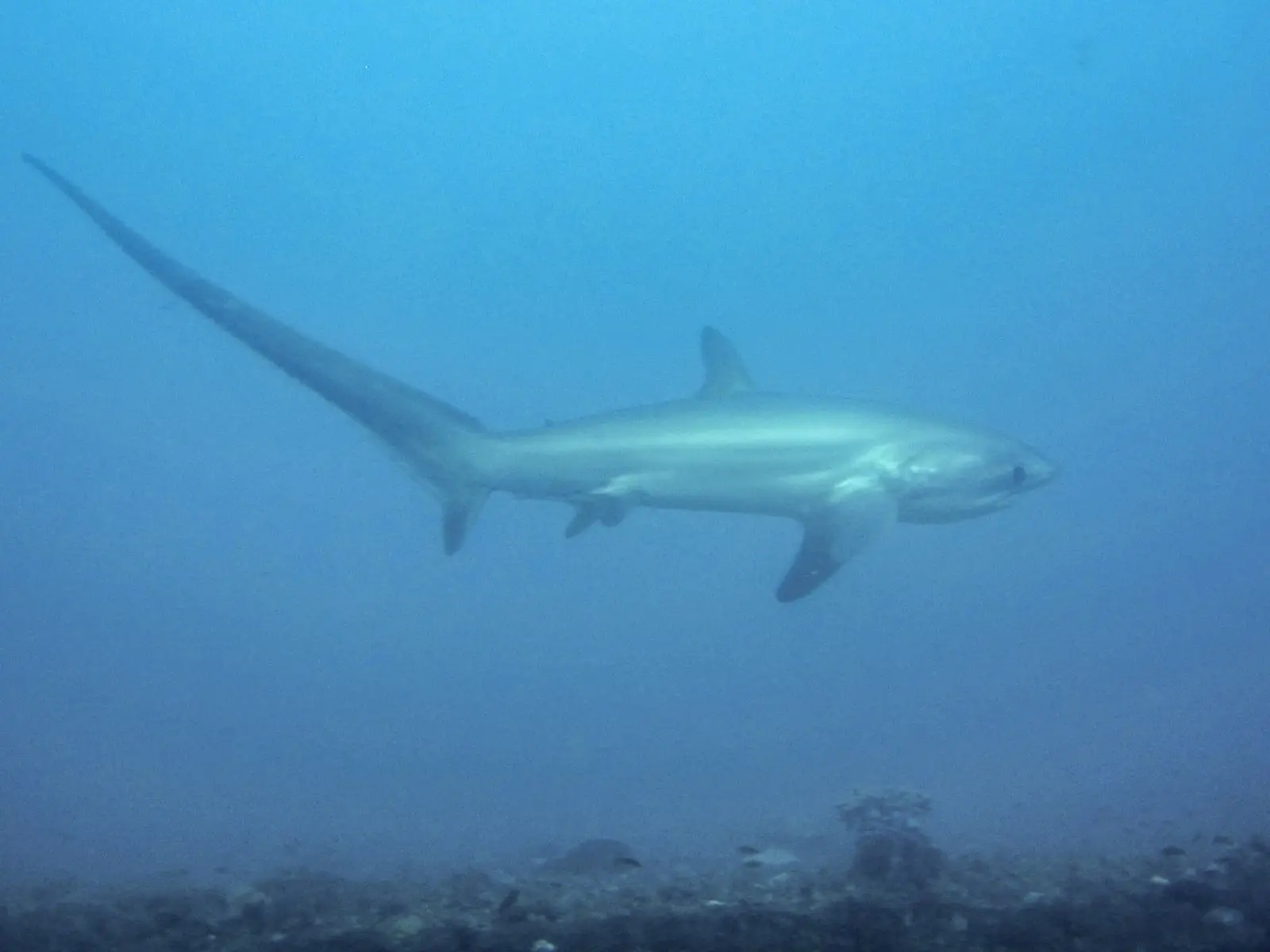
Malapascua, off Cebu's northern tip, is the world's most reliable place to dive with pelagic thresher sharks. Boats leave at dawn for seamount cleaning stations — Kimud Shoal since 2022, or the original Monad Shoal — where the sharks rise from deep water to be cleaned by wrasse. Sightings are reported on the large majority of morning dives, all year.
Best time: Daily, year-round — there is no closed season
Well documented, and reliably seen in season.
When to go
Unlike a migratory species, the threshers here are reported daily and year-round, which is exactly what makes Malapascua unusual. Conditions still shift with the monsoon: the Amihan (November–February) brings choppier seas and visibility sometimes down to 10–15 m, while the Habagat (June–October) brings heavier rain that tends to fall in afternoon bursts and usually leaves the morning shark dive alone. Visibility is generally best March through June.
Best dive sites for thresher sharks in the Philippines
-
Kimud Shoal
The primary thresher site since sightings shifted here from Monad in September 2022. Cleaning stations sit at roughly 12–22 m, about 45 minutes out by boat, and the shoal is now a declared Marine Protected Area.
-
Monad Shoal
The original site, studied since 2005, where the cleaning-station behaviour was first documented. Threshers largely stopped appearing here after 2022, though it is still dived for other pelagics.
How to see them
Boats have traditionally left Malapascua before sunrise, around 4:30–5:30am, because sightings at Monad Shoal were concentrated in the first hour of daylight at 25–30 m — deep enough that Advanced certification was effectively required, with divers holding position behind roped lines at the drop-off edge. Since the sharks shifted to shallower Kimud Shoal in 2022, operators report sightings running later into the morning, and the 12–22 m stations let some Open Water divers join with an instructor, plus a buoyancy workshop if they have under 50 logged dives. Kimud's MPA rules require 5 m minimum distance, ban reef hooks, pointers and gloves, and prohibit strobes or strong lights aimed at the animals. A sanctuary fee applies on top of the dive cost.
What an encounter is like
This is closer to a stakeout than a reef dive: you kneel or hover quietly near a drop-off in dim early light and wait. Cleaner wrasse work over a shark's fins and tail while it circles slowly through the station, sometimes coming close if you stay still and keep your bubbles down. One long-running local operator quotes roughly a 90% sighting rate and gives a free extra dive if none appear — but nothing is guaranteed. Some mornings produce one distant shark, others ten circling repeatedly.
Frequently asked questions
- Where exactly do thresher sharks show up in Malapascua?
- At seamount cleaning stations reached by boat: Kimud Shoal, the primary site since the sharks shifted there in September 2022, and Monad Shoal, the original site where researchers first documented the behaviour in 2005. Many guides still name Monad by default, so check which shoal your operator is running.
- Do I need Advanced Open Water to dive with the threshers?
- Not always, any more. Kimud Shoal's stations sit at 12–22 m, and Open Water divers can join with an instructor — plus a buoyancy workshop if they have fewer than 50 logged dives — under the MPA rules. Monad Shoal's deeper 15–30 m stations still call for Advanced-level experience.
- What time do the dive boats leave?
- Traditionally before dawn, around 4:30–5:30am, because Monad sightings were concentrated in the first hour of daylight. Since the move to Kimud, operators report sightings continuing later into the morning, though early departures remain the norm.
- Are thresher shark sightings guaranteed?
- No, but the odds are high — one long-running local operator quotes roughly a 90% sighting rate and offers a free extra dive if none turn up. How many you see varies from a single distant animal to ten or more.
Sources
- Oceanic Sharks Clean at Coastal Seamount (Monad Shoal study) — PLOS ONE
- Alopias pelagicus, Pelagic Thresher — IUCN Red List
- Diving Kimud Shoal in Malapascua: New MPA Rules for Thresher Shark Encounters — Sea Explorers
- Thresher Sharks at Kimud Shoal, Malapascua — Thresher Shark Divers