Animal profile
Where to see wobbegongs
Family Orectolobidae
Regular, but it has to want to be seen. Odds on a typical dive within its range — the right place and season are what beat them, which is what the destinations below are for.
Varies across the family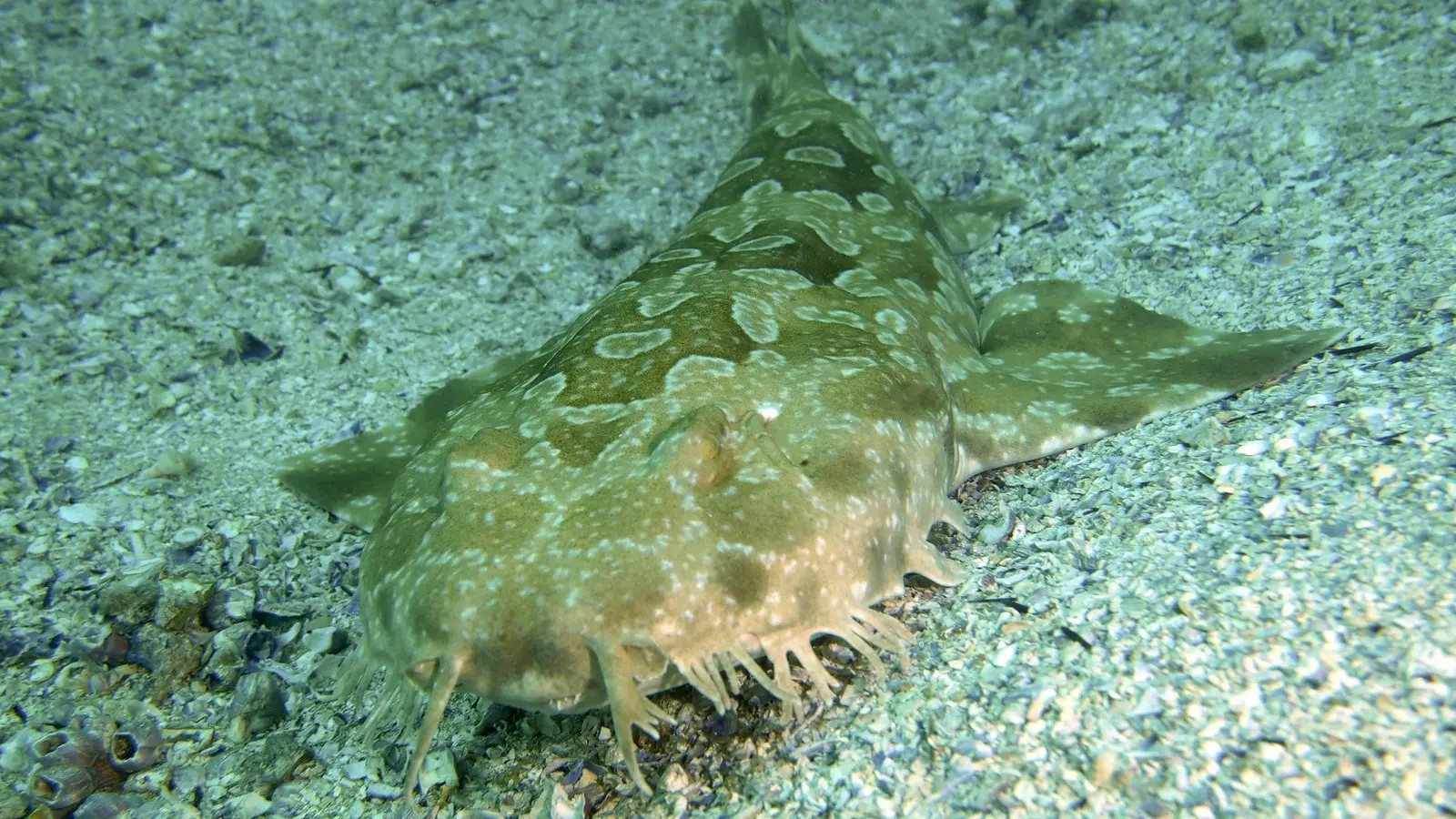
Wobbegongs are bottom-dwelling ambush sharks: broad, flattened bodies pressed to sand and reef, a mottled carpet pattern, and a fringe of skin lobes around the jaw that breaks up their outline. The name is thought to come from an Australian Aboriginal word for 'shaggy beard'. There are about a dozen species across the shallow western Pacific and eastern Indian Ocean, and Australia is the heart of the family — the spotted (Orectolobus maculatus) and ornate wobbegongs are the ones a diver meets resting under ledges and boulders there. The most ornate of all is the tasselled wobbegong (Eucrossorhinus dasypogon) of the Coral Triangle, whose beard rings the entire head. They lie motionless by day and hunt fish, crustaceans and cephalopods by ambush at night; docile as they look, they bite hard if grabbed, fed or stepped on.
Size
The short version
Solitary
usually met one at a time
Diet
Fish, crustaceans and cephalopods, ambushed at night
Risk to youModerate
Bites when stepped on or grabbed, and does not let go quickly.
Risk from us
stepping on them, targeted fishing — the last one is the part you control.
Planning the encounter
Depth
5–20 m
Recorded between 3 m and 25 m
Night diving
Better on a night dive
Odds through the day
Dawn
possible
Day
likely
Dusk
likely
Night
likely
Nocturnal ambush hunters, which cuts both ways: by day they lie motionless under a ledge and are easy to find, by night they are out and moving.
Best places to see wobbegongs
How to identify a wobbegong
- A flat, broad body lying still on sand or reef, not a shark swimming in open water — wobbegongs are sit-and-wait ambush hunters.
- A fringe of skin lobes — the 'beard' — around the jaw, and a carpet-like pattern that matches the bottom rather than any bold marking.
- In Australia the spotted and ornate wobbegongs rest under ledges and boulders; in Raja Ampat the tasselled wobbegong tucks under table corals, its beard ringing the whole head.
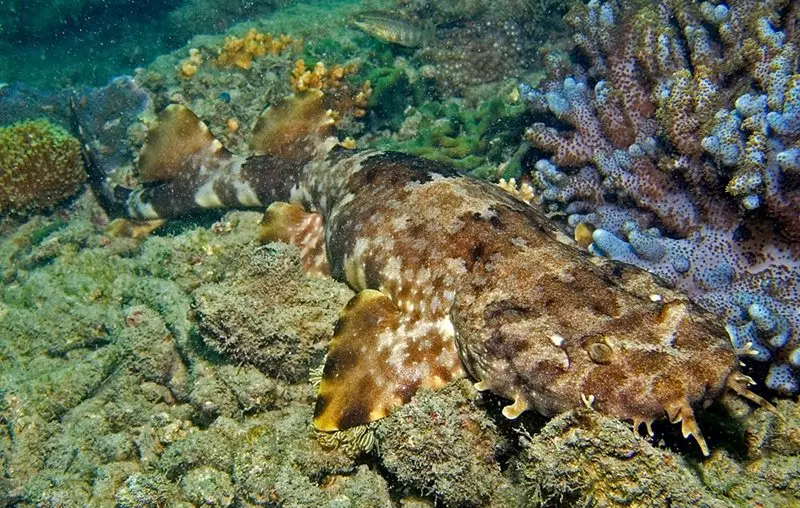
Wobbegong, photographed at the Great Barrier Reef, Queensland. Photo by Andrew J. Green / Reef Life Survey · CC BY 4.0
Meeting them responsibly
- Never touch, poke or corner one. It looks inert, but it bites defensively — and it is hard to detach once it has.
- Watch where your hands and fins land when you look under a ledge. It won't move away, so accidental contact is on you.
- Keep a body length back and let the guide point it out rather than reaching in for the photo.
Frequently asked questions
- How many wobbegong species are there, and where do they live?
- About a dozen, across the shallow western Pacific and eastern Indian Ocean. Australia is the family's heartland — the spotted and ornate wobbegongs are the common ones there — while the tasselled wobbegong is the Coral Triangle's, best known from Raja Ampat.
- Are wobbegongs dangerous?
- They won't chase you, but they are ambush predators that bite defensively if touched, stepped on or cornered. Case files record dozens of unprovoked bites on divers and swimmers — none fatal, but the small sharp teeth go through a wetsuit and the shark can be hard to release.
- Why are they called wobbegongs?
- The name is thought to come from an Australian Aboriginal language, meaning roughly 'shaggy beard' — a reference to the branching skin flaps fringing the shark's mouth and head.
Check me
The reference records behind this page on wobbegong.