Animal profile
Where to see leopard sharks
Stegostoma tigrinum
Regular, but it has to want to be seen. Odds on a typical dive within its range — the right place and season are what beat them, which is what the destinations below are for.
ENEndangered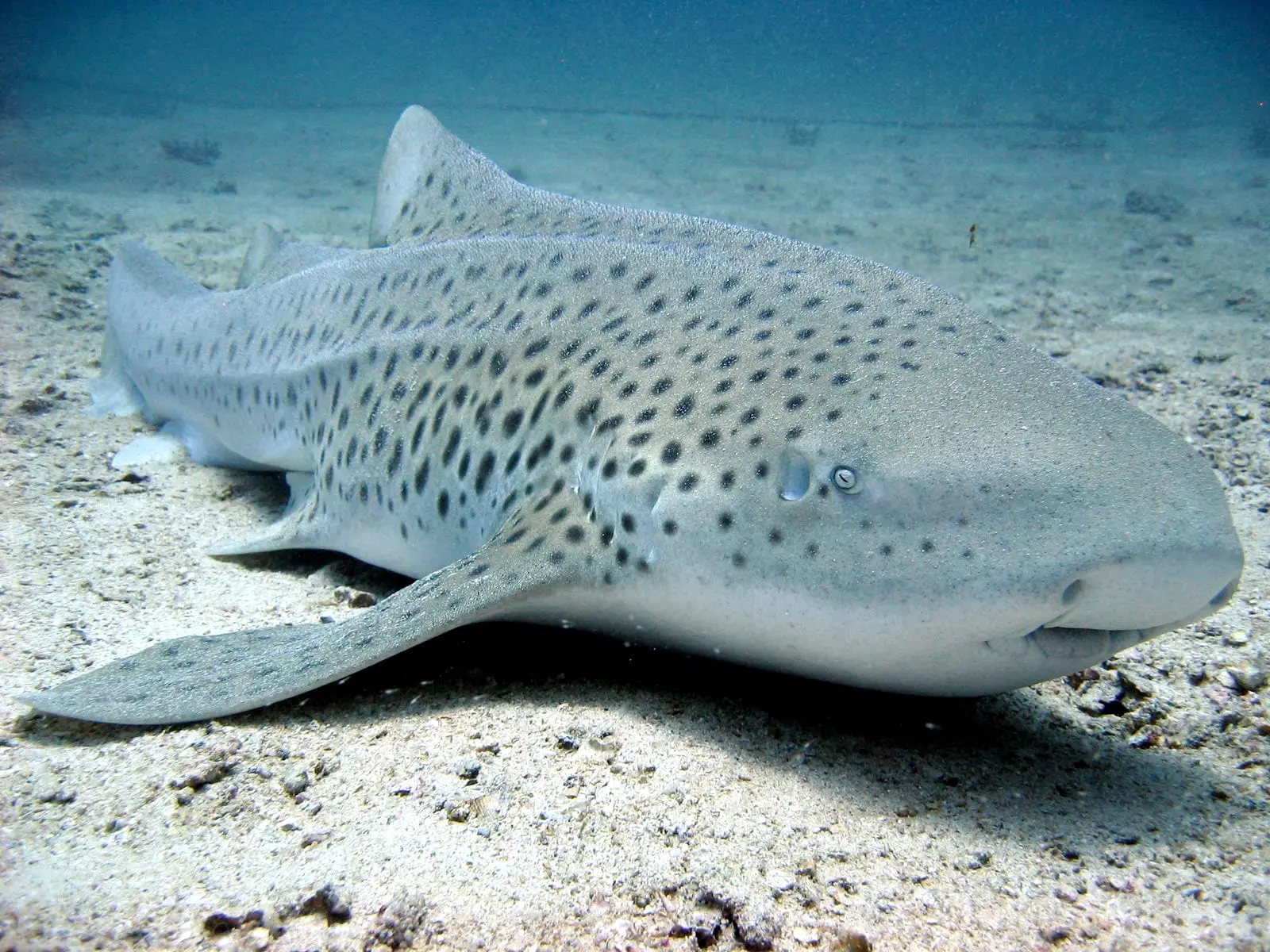
The leopard shark, known as the zebra shark through much of the world, is a large Indo-Pacific carpet shark that spends its days lying motionless on sandy patches between reef and rubble. It can do that because it pumps water over its own gills rather than needing to swim to breathe, which makes it one of the few big sharks a diver can watch at rest. At night it works reef crevices for molluscs and crustaceans, finding prey with barbels on its snout and crushing it with flattened teeth. Adults are tan with dark spots and an enormously long tail; juveniles are boldly striped in cream and brown and look convincingly like a different species, which is how one animal ended up with two contradictory names.
Size
The short version
Lifespan
~25 years
Solitary
usually met one at a time
Diet
Molluscs, crabs, shrimp, sea urchins and small fish
Risk to youHarmless
Docile and slow; rests on sand and tolerates a calm approach.
Risk from us
finning, crowding while resting — the last one is the part you control.
Planning the encounter
Depth
5–30 m on sand
Recorded between 0 m and 90 m
Night diving
Also seen on night dives
Odds through the day
Dawn
possible
Day
possible
Dusk
possible
Night
best time
Largely nocturnal, and worth understanding the paradox: they forage at night and rest motionless on open sand through the day, which is exactly why divers see them. Daytime bars here mean low activity, not low odds — a sleeping shark is the easiest shark in the sea to find. One seen swimming in daylight has usually been pushed off its spot by an earlier group.
Best places to see leopard sharks
Well documented, and reliably seen in season.
Best time: November to April, the Andaman dry season
Well documented, and reliably seen in season.
Best time: December to April, peaking January to March
Best time: October to April, the general Raja Ampat season — no shark-specific peak
How to identify a leopard shark
- The tail is nearly as long as the rest of the shark, trailing behind a resting animal like a ribbon. From a distance that silhouette is the fastest identification there is.
- Prominent ridges run the length of the back and flanks, giving a squared, keeled body rather than a round one, on a tan base covered in small dark spots.
- Juveniles look like a different animal entirely — dark brown with bold cream bars. That striping is the origin of "zebra shark"; the adult spotting is the origin of "leopard shark".
Meeting them responsibly
- Never touch, including a "gentle" fin-tip touch or a grab at the tail for a photograph. This is one of the most routinely harassed sharks in the world precisely because it holds still.
- Never block the escape route. Approach from one side only, leave the sand open on at least one flank, and do not let a group form a ring around a resting animal.
- Do not kneel or settle on the reef to steady a shot. Hover — silting out the resting patch ruins the site for the next boat and does more lasting damage than the photo is worth.
Frequently asked questions
- Is a leopard shark the same as a zebra shark?
- Yes — one species, two names, taken from two life stages. Striped juveniles gave it "zebra shark", spotted adults gave it "leopard shark". Confusingly, "leopard shark" in California means Triakis semifasciata, a completely unrelated houndshark.
- Where can I reliably see leopard sharks?
- Thailand's Andaman coast year-round — Shark Point off Phuket is named for them — and Julian Rocks at Byron Bay in the Australian summer, which hosts the largest known aggregation of the species.
- Are leopard sharks dangerous?
- No. They are slow, docile bottom-dwellers that eat shellfish, and they will leave rather than confront a diver. The risk runs the other way: repeated disturbance drives them off a site permanently.
Check me
The reference records behind this page on leopard shark.