Cenderawasih Bay, West Papua
Where to see whale sharks in Indonesia
Cenderawasih Bay in West Papua holds Indonesia's largest confirmed whale shark population — a resident, non-migratory group that gathers around traditional bagan fishing platforms in Kwatisore Bay. Access is liveaboard-only. Note that sightings here track baitfish from the platforms rather than a natural plankton bloom.
Best time: Year-round resident population; best conditions June to October
Well documented, and reliably seen in season.
When to go
Sightings are effectively year-round because the sharks are resident and tied to a man-made food source rather than following a bloom or a migration, unlike Donsol or Sogod Bay. There is no closed season. Most liveaboards schedule Cenderawasih from roughly June to October — the drier months — for calmer crossings and better visibility, not because the sharks are more numerous then.
Best dive sites for whale sharks in Indonesia
-
Kwatisore Bay bagans
The core viewing area inside Cenderawasih Bay National Park, where several lift-net platforms hold resident sharks feeding on baitfish.
-
Other bagan platforms across the national park
Additional lift-net rigs scattered through the roughly 1.4-million-hectare park; some itineraries visit these when Kwatisore is busy.
How to see them
Cenderawasih is liveaboard-only — there is no shore-based operation. Most itineraries route through Jakarta to Biak or Nabire, then transfer to the boat. The bagans are traditional wooden lift-net rigs worked since roughly the 1960s, keeping live baitfish in submerged nets; whale sharks learned to feed on fish that escape or are tossed to them, and the fishermen have long treated the sharks' presence as a good omen. Snorkellers and divers enter beside the platform while fishing continues around them. Interaction rules are set by individual operators and the park rather than one standardised programme, so practice varies more between boats than at a centrally regulated site like Donsol.
What an encounter is like
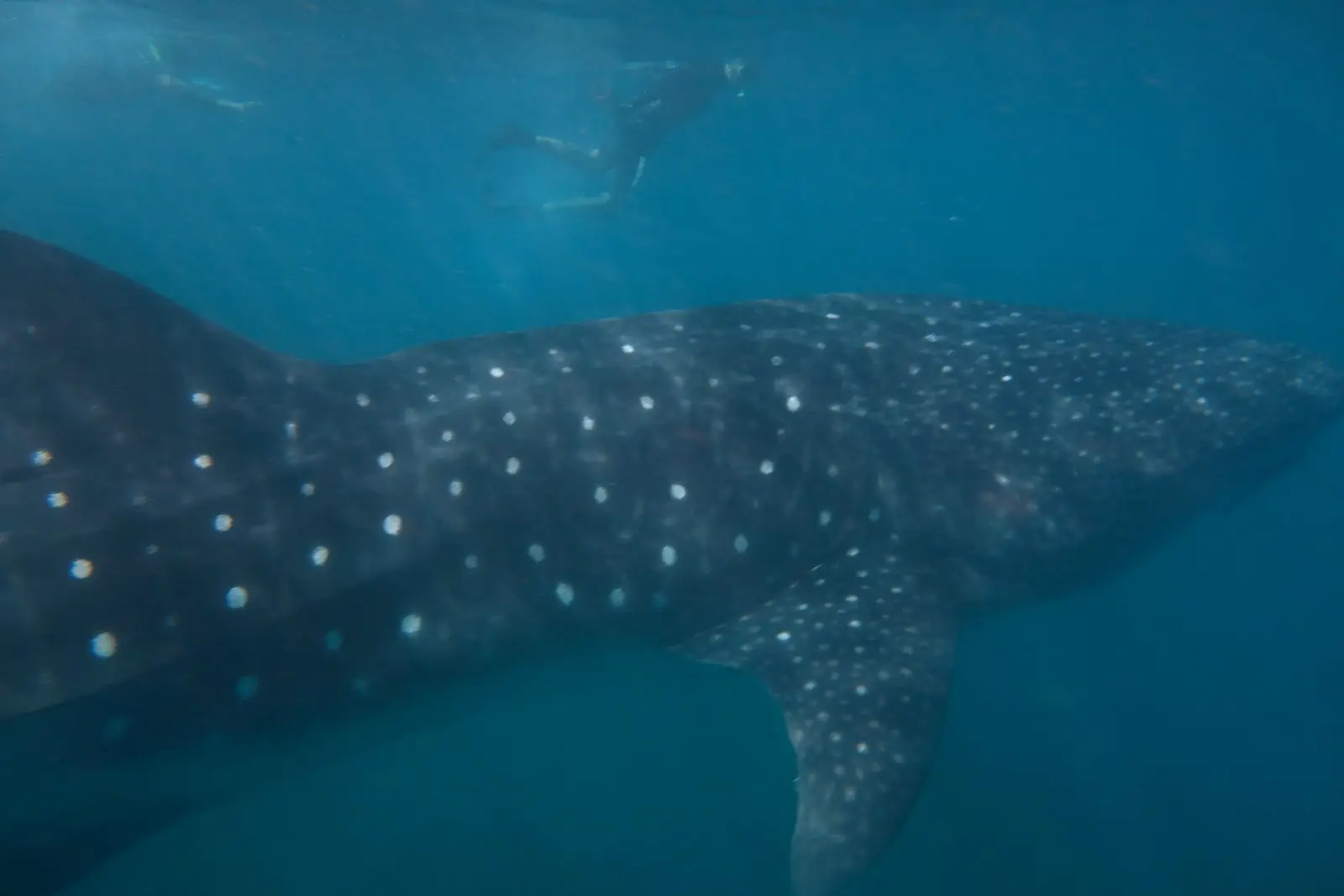
Encounters can be unusually close and long: several sharks — occasionally up to a dozen at one platform — feeding vertically at the surface in a few meters of clear water, largely unbothered by swimmers. That is a direct result of the bait, not a chance wild pass, so it sits closer to a provisioned encounter than a natural one. Photo-ID work from 2010–2023 recorded 159 individuals with a mean residency of about 77 days and up to roughly 26 sharks present on a given day — genuine residents. The same research found scarring on about 74% of them, mostly abrasion from the bagan structures rather than propellers, which the authors flag as needing better platform design and traffic management.
Frequently asked questions
- Are Cenderawasih Bay's whale sharks fed, and how does that compare to Oslob?
- Yes — the sharks feed on baitfish released or tossed from the bagan lift-nets, which is a form of provisioning. It differs from Oslob in origin: the association grew out of a subsistence fishery that predates tourism rather than being created to hold sharks in place for paying visitors. But it is not impact-free — research found roughly three-quarters of these sharks carry scarring, mostly from bagan contact — so it isn't a purely wild encounter either.
- How do you get to Cenderawasih Bay?
- Fly to Jakarta, connect to Biak or Nabire in West Papua, then join a liveaboard — there is no land-based operation reaching the platforms. Most itineraries run June to October.
- What time of year can you see whale sharks in Cenderawasih Bay?
- Essentially year-round. These are residents feeding at the platforms rather than a migratory group chasing a seasonal bloom, so there is no true off-season — though most liveaboards run June to October for calmer conditions.
- How many whale sharks live in Cenderawasih Bay?
- A 2010–2023 photo-identification study recorded 159 individuals across 551 sightings, with an average residency of about 77 days per shark and an estimated 26 present on any given day — a genuinely resident rather than transient population.
Sources
- Population demographics and residency patterns of photo-identified whale sharks in the Bird's Head Seascape, Indonesia — Frontiers in Marine Science (Setyawan et al., 2025)
- Nearly 80% of whale sharks in this marine tourism hotspot have human-caused scars — Frontiers Science News
- Decade-long whale shark study highlights need to protect broader habitat across the Indo-Pacific — Conservation International